Contents
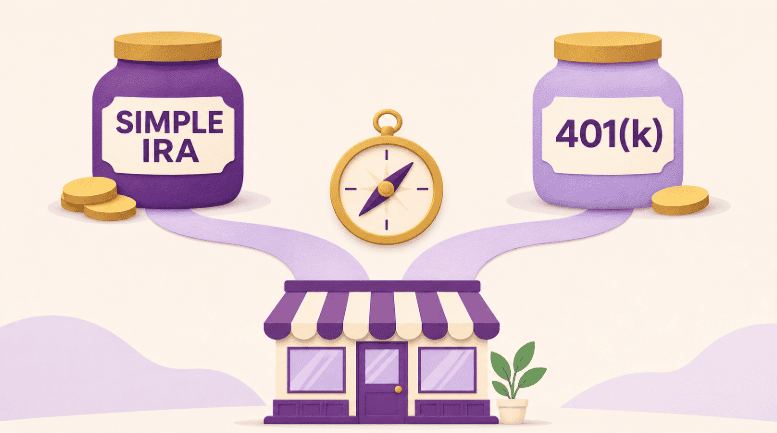
You want to offer a retirement plan. Your team will notice, your best people may stay longer, and the tax savings are real. Then you hit the same fork everyone does: SIMPLE IRA or 401(k)?
Most comparison articles list features and stop. This one starts with the question you are actually asking: what will this cost me, how much work is it, and will I outgrow it?
The short answer
For most businesses with fewer than 100 employees, a SIMPLE IRA gives your team a real, tax-advantaged retirement benefit for much less cost and paperwork than a 401(k). It has no annual Form 5500 filing and no nondiscrimination testing. A 401(k) is the better choice when you or your key people want to contribute much more, when you are near or above 100 employees, or when you need features like loans, Roth-heavy design or custom vesting.
- Cost and admin: A SIMPLE IRA has no Form 5500 and no annual testing. A 401(k) requires both, plus recordkeeping.
- Contribution limits (2026): An employee can defer up to $17,000 into a SIMPLE IRA, or $24,500 into a 401(k).
- Employer contribution: SIMPLE IRA is required to be 3% match or 2% for everyone. A safe harbor 401(k) is commonly about 4%.
- Size cap: A SIMPLE IRA is for employers with 100 or fewer employees who earned at least $5,000 in the prior year.
- Exclusivity: A SIMPLE IRA generally must be your only retirement plan.
- Setup: SIMPLE IRAs can be set up online in minutes with WealthRabbit. 401(k)s usually take longer.
SIMPLE IRA vs 401(k) side by side
| Category | SIMPLE IRA | 401(k) |
|---|---|---|
| Best for | Up to 100 employees | Larger teams, higher contributions |
| Employee deferral limit (2026) | $17,000 (up to $18,100 in certain cases) | $24,500 |
| Catch-up, age 50+ (2026) | $4,000 | $8,000 |
| Catch-up, age 60 to 63 (2026) | $5,250 | $11,250 |
| Total limit per person | Deferral plus required employer contribution | Up to $72,000 combined, under age 50 |
| Employer contribution | Match up to 3%, or 2% of pay for all eligible | Optional, or safe harbor (commonly about 4%) |
| Form 5500 | Not required | Required every year |
| Annual nondiscrimination testing | None | Required, unless safe harbor |
| Loans | Not allowed | Allowed if the plan permits |
| Vesting | Employees own all contributions immediately | Can use a vesting schedule on employer money |
| Cost with WealthRabbit | $29/mo plus $4 per employee | Typically higher: admin, recordkeeping, testing |
| Setup time | About 10 minutes online | Longer, often advisor-assisted |
What it really costs: a worked example
Say you run a business with 20 employees and $1,000,000 in total payroll.
Plan cost (SIMPLE IRA with WealthRabbit): $29 plus 20 x $4 = $109 a month, or about $1,308 a year.
Employer contribution: The match only gets paid on money employees actually put in. That is where owners often misjudge the numbers.
| If employees covering this share of payroll participate | SIMPLE IRA match (3%) | Safe harbor 401(k) (about 4%) | Difference |
|---|---|---|---|
| 100% | $30,000 | $40,000 | $10,000 |
| 60% | $18,000 | $24,000 | $6,000 |
| 40% | $12,000 | $16,000 | $4,000 |
So the “$10,000 a year” figure is the best case. Even with typical participation, the SIMPLE IRA match is lower, and you skip 401(k) administration and testing on top. (Illustrative only. A 401(k) can also be designed without a safe harbor match, but then you take on annual testing and the risk of refunding contributions to higher-paid employees.)
How the employer contribution works
SIMPLE IRA: you pick one of two formulas.
- Match: You match employee deferrals dollar for dollar, up to 3% of pay. In limited years you can reduce this to as low as 1%, if you tell employees in advance.
- Nonelective: You contribute 2% of pay for every eligible employee, even those who do not contribute
Safe harbor 401(k): The common basic formula is 100% of the first 3% an employee defers, plus 50% of the next 2%, which is a 4% maximum cost. The alternative is a 3% contribution for everyone. Either one lets you skip the annual testing that catches many small-business 401(k)s.
When a 401(k) is the better call
Choose a 401(k) when:
- Owners or key employees want to save more. A 401(k) allows far higher personal contributions and employer contributions than a SIMPLE IRA.
- You are close to 100 employees. A SIMPLE IRA has a size limit. If you cross it, there is a grace period, but you should plan ahead.
- You want plan features a SIMPLE IRA does not allow, such as loans or a vesting schedule to encourage retention.
- You want a profit-sharing component that rewards the whole team in strong years.
- You want to run another plan alongside. A SIMPLE IRA generally has to be your only plan.
When a SIMPLE IRA wins
Choose a SIMPLE IRA when:
- You have fewer than 100 employees and want a benefit people understand.
- You want low, predictable cost with no yearly filings.
- You want to start fast, and avoid long implementation.
- You want employees to own their contributions immediately, which makes the benefit feel real.
- You do not want to risk failed testing, which forces refunds to your highest earners.
Questions small business owners also ask
- Can I switch from a SIMPLE IRA to a 401(k) later? Yes. Many businesses start with a SIMPLE IRA and move to a 401(k) as they grow. Timing and the plan’s rules matter, so plan the move before year end, and ask your plan provider or tax professional.
- Is there a deadline to start a SIMPLE IRA? For an existing business, a SIMPLE IRA generally has to be set up by October 1 to take effect for that year. Since it is already November, a new plan would typically start January 1, 2027, so now is the time to prepare.
- What happens if my employee leaves? In both plans, an employee keeps their own contributions. With a SIMPLE IRA they also keep your match, since there is no vesting schedule.
- Can employees take money out early? Both plans generally penalize early withdrawals before age 59 and a half. A SIMPLE IRA has a steeper penalty (25%) on withdrawals in the first two years of participation.
- Are there Roth options? Roth contributions are now allowed in SIMPLE IRAs and 401(k)s, if your plan offers them.
- Are there tax credits for starting a plan? Small employers may qualify for credits for plan startup costs and employer contributions under SECURE 2.0. Eligibility depends on your size and plan type, so confirm with a tax professional.
A simple way to decide
Answer these four questions:
- Will you have more than 100 employees soon? If yes, lean toward a 401(k).
- Do owners need to save well beyond $17,000 a year through the plan? If yes, lean toward a 401(k).
- Do you want zero annual filings and no testing? If yes, lean toward a SIMPLE IRA.
- Is your priority a low-cost benefit to attract and keep people? If yes, lean toward a SIMPLE IRA.
If you land mostly on SIMPLE IRA answers, you probably have your plan.
The bottom line
A 401(k) is not the “better” plan, and a SIMPLE IRA is not the “lesser” one. They are built for different stages. If you have fewer than 100 employees and want a plan your team values without the overhead, a SIMPLE IRA is very likely the better fit. With WealthRabbit it takes about 10 minutes to set up.
See your savings: Run your numbers with the WealthRabbit savings calculator, or talk to us and we will help you choose the right plan.
FAQs
- IRS, 401(k) limit increases to $24,500 for 2026, IRA limit increases to $7,500 (IR-2025-111, Nov. 13, 2025). It links to Notice 2025-67, the full 2026 cost-of-living adjustments.
- IRS, Retirement topics: SIMPLE IRA contribution limits
- IRS, SIMPLE IRA plan
- IRS, Choosing a SIMPLE IRA plan. It covers the 100-employee limit, no IRS filing requirement and the startup tax credit.
- IRS, 401(k) plan overview. It covers traditional, safe harbor and SIMPLE 401(k) types.
- IRS, 401(k) resource guide: Plan sponsors, filing requirements
- IRS, Publication 560: Retirement Plans for Small Business
About the Author

Not sure which plan fits?
Answer three quick questions about team size and budget - we'll match you to a plan, no reading required.