Contents
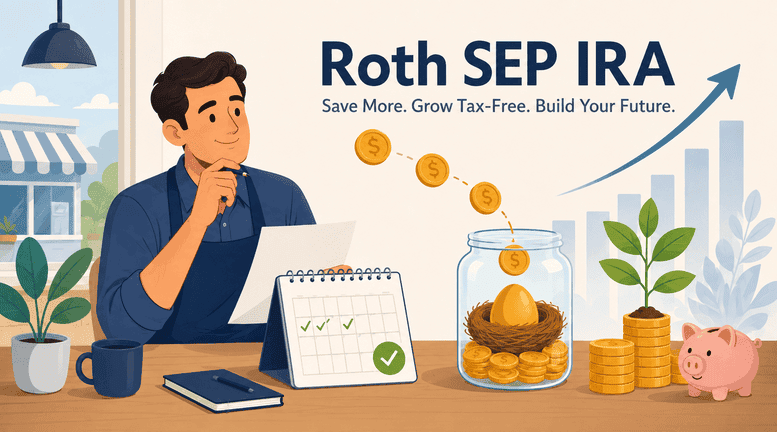
A Simplified Employee Pension (SEP) IRA is a retirement plan designed for self-employed individuals and small business owners. It allows employers to contribute to their own retirement as well as to their employees’ individual SEP IRAs.
Each participant has their own IRA, and the rules for investing, withdrawing, and rolling over funds are similar to those of traditional IRAs.
This guide will walk through the basics of establishing a SEP IRA, participation rules, contribution limits, and how business owners can benefit from this flexible retirement plan.
Features of a SEP IRA:
- High contribution limits – The SEP IRA contribution limit for 2025 is 25% of an employee's total compensation, up to $70,000.
- Employer-funded only – Employees cannot contribute; only the employer makes contributions.
- Flexible contributions – Employers can adjust contributions each year based on business performance.
- Easy setup – Unlike 401(k) plans, SEP IRAs are simple to set up and maintain. In most cases, employers only need to complete IRS Form 5305-SEP to establish the plan.
- Low maintenance – No need to file with the IRS, SEP IRAs require minimal ongoing maintenance and are exempt from annual compliance testing.
- Tax advantages – Contributions are tax-deductible, reducing the business’s taxable income.
Who Can Establish a SEP IRA?
- Any business owner, including sole proprietors, freelancers, and self-employed individuals.
- Partnerships can set up a SEP IRA on behalf of the business (not individually per partner).
- Individuals with side businesses can set up a SEP even if they’re part of another employer’s retirement plan.
Who Can Participate in a SEP IRA?
An employee must be included in a SEP plan if they:
- Are at least 21 years old
- Have worked for the employer in at least three of the last five years
- Earned at least $750 in 2023
Employers may choose less restrictive rules but must apply them equally to all employees, including owners. Contributions must be based on full-year compensation once eligibility is met.
Important Notes:
The same eligibility rules must apply equally to owners and employees.
- If a business is owned by spouses, both must meet the eligibility requirements to receive contributions.
- Employers cannot prorate contributions based on when an employee meets the eligibility threshold—once eligible, the contribution is based on the entire plan-year compensation.
Contribution Rules
Employer Contributions
- Must be made in cash, not property.
- Must be the same percentage of salary for all eligible employees.
- Participant contributions are not allowed.
- Cannot exceed 25% of compensation or $70,000 in 2025.
Self-Employed Contributions
- Use a modified formula based on net earnings, minus self-employment tax and the contribution itself.
- Refer to IRS Publication 560 for detailed calculations.
Commonly Asked Questions
1. Do employers have to contribute every year?
No, a SEP IRA does not require annual contributions. Employers can choose whether to contribute each year. However, if a contribution is made, it must be distributed to all eligible employees, even those who are no longer with the company.
2. Are catch-up contributions allowed?
Unlike traditional IRAs and 401(k) plans, SEP IRAs do not allow catch-up contributions for employees over age 50.
3. What are the tax benefits of a SEP IRA?
- Employers can deduct SEP IRA contributions on their business tax return.
- Employee contributions are not taxable to the employee when deposited.
- Self-employed individuals can deduct SEP IRA contributions using IRS Form 1040.
4. What are the deadlines for SEP IRA contributions?
Employers must make contributions by the business's tax filing deadline, including extensions. If contributions are made after this deadline, they cannot be deducted for that year.
5. Who ensures compliance?
The employer is responsible for:
- Correct plan setup
- Following contribution rules
- Keeping up with IRS changes
- Accurate records are maintained
6. What happens if an employer fails to contribute?
If an employer does not make the required contributions, the SEP IRA may lose its tax benefits. However, certain failures can be corrected under IRS programs.
Is a SEP IRA Right for You?
- Self-employed individuals or freelancers
- Small businesses with few or no employees
- Businesses with variable income
- Owners who want to contribute more than SIMPLE IRA limits allow
How WealthRabbit Simplifies SEP IRA Management
WealthRabbit makes setup and management easy with:
- Step-by-step digital onboarding—no printing or mailing
- Payroll integration—automated, accurate contributions
- Easy rollovers—transfer existing retirement funds seamlessly
- Employer dashboard—manage accounts from any device
- Automated contributions—schedule and track with ease
- Real-time tracking—monitor investments and contributions
- Compliance support—stay on top of deadlines and rules
WealthRabbit helps self-employed professionals and small business owners start building retirement savings—fast, simple, and secure.
Not sure which plan fits?
Answer three quick questions about team size and budget - we'll match you to a plan, no reading required.