
Why choose a Roth IRA
With a Roth IRA, you contribute after-tax dollars today, and your investments grow tax-free. Qualified withdrawals in retirement are completely tax-free, helping you maximize your retirement income.
Tax-free growth
Contribution and investment in the Roth IRA grow tax-free, Maximizing your retirement savings.
Tax-free withdrawals
Withdrawals are tax- and penalty-free if you're age 59½ or older and have met the five-year minimum holding period.
Easy eligibility
Anyone with earned income can contribute to a Roth IRA at any age. Income limits apply.
No Required Minimum Distributions (RMDs)
Unlike Traditional IRAs, you won't be forced to withdraw at age 73.
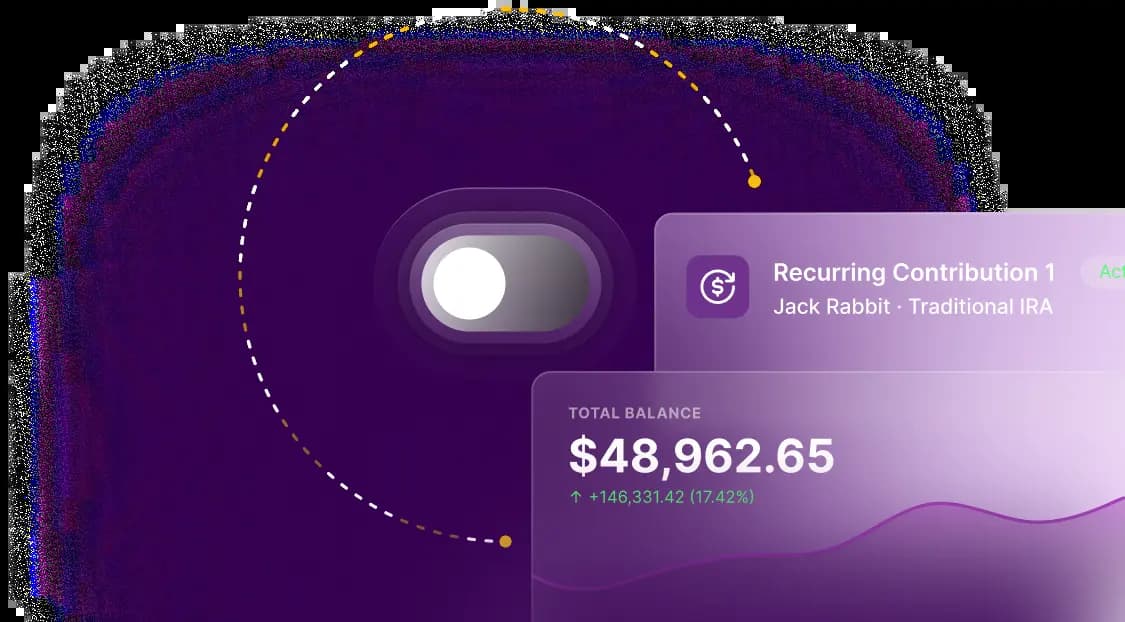
Set up a recurring contribution once. Then never think about it again.
Over the Roth IRA Limit?
There's still a way in.
If your income is above $173,000 (single) or $260,000 (joint), you're no longer eligible to contribute directly to a Roth IRA. But that does not close the door on tax-free retirement growth. The Backdoor Roth IRA is a legal two-step strategy that gives high earners access to the same benefits, regardless of income.[1]
Single Filers Limit
Income where direct Roth contributions phase out completely
Joint Filers Limit
Income where joint filers lose direct Roth eligibility
Annual Contribution
$8,600 if you’re age 50 or older
Income Cap on Conversion
Anyone can convert a Traditional IRA to a Roth IRA
How the Backdoor Roth IRA Works
Traditional
Roth IRA
Which path is right for you?
Roth IRA eligibility depends on your income. Find the strategy that fits where you are today.
Roth IRA
Under $158K (single) / $250K (joint)
You're fully eligible to contribute directly to a Roth IRA. Between $158K and $173K (single) or $250K and $260K (joint), you can contribute a reduced amount. Open your account in minutes with no monthly fee and start growing tax-free.
Backdoor Roth IRA
Above $173K (single) / $260K (joint)
Direct contributions are no longer an option at this income level, but the Backdoor Roth strategy keeps the door open for tax-free retirement growth.
We take care of the admin so you don't have to
From setup to compliance, WealthRabbit runs your Roth IRA in the background so it just... works.
Fully digital setup
No paperwork, no back-and-forth. Open your account and fund your first contribution in about 14 minutes, start to finish.

Seamless rollover
Bring over an old 401(k) or IRA without lifting a finger. We coordinate directly with your previous provider and keep you posted the whole way.

Flexible contribution options
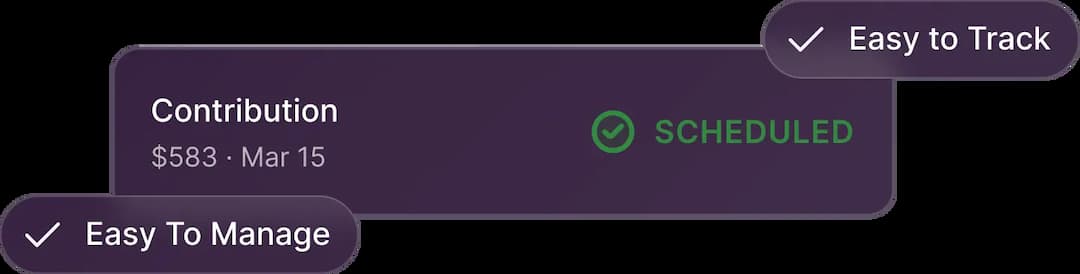
Contribute on your own terms, weekly, monthly, quarterly, or all at once. Adjust the amount any time your plans change.

Simple, live dashboard
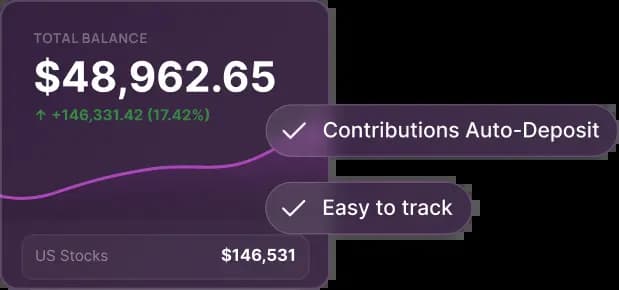
Track your balance, growth, and contributions in one place, updated in real time so you always know where you stand.

Set Up Your Roth IRA
in Minutes
Set up your account, choose your contribution frequency, and let WealthRabbit handle the rest, all from one streamlined digital platform.


Start planning today with free Roth IRA account
One plan. Everything included. No hidden fees.
What you will get
- Easy setup in minutes
- No account setup fee
- Wide range of investment options
- Tax-free withdrawals
- No Required Minimum Distribution
What you will get
- Easy setup in minutes
- No account setup fee
- Wide range of investment options
- Tax-free withdrawals
- No Required Minimum Distribution
Trusted by Businesses,
Accountants & Individuals
Small business owners, freelancers, and CPAs across the country rely on WealthRabbit for their team's retirement future.



Testimonials describe experiences with our software. They don't reflect investment performance or endorse any portfolio strategy.
Frequently asked questions
A Roth IRA is an individual retirement account funded with after-tax money. You get no deduction when you contribute, but your investments grow tax-free and qualified withdrawals in retirement are tax-free. Anyone with earned income who meets the income rules can open one, and there is no age limit for contributing.
The 2027 limit is $7,500, or $8,600 if you are age 50 or older. This is a combined limit across all your Roth and Traditional IRAs, not per account. You also cannot contribute more than your taxable earned income for the year, and the limit may be reduced if your income is in the phase-out range.
For 2027, the contribution phase-out is $158,000 to $173,000 of modified AGI for single filers and heads of household, and $250,000 to $260,000 for married couples filing jointly. Below the range you can contribute the full amount, within it a reduced amount, and above it nothing directly. For married filing separately, the range is $0 to $10,000.
Qualified withdrawals are tax-free and penalty-free. To qualify, your first Roth IRA must have been open at least five tax years, and you must be 59½ or older, disabled, or the withdrawal must go to a beneficiary after death. Using up to $10,000 for a first-time home purchase can also qualify if the five-year rule is met.
Yes. Money you contributed directly can be withdrawn at any age without income tax or the 10% penalty, because you already paid tax on it. The five-year rule and age 59½ requirement apply to earnings. Early withdrawals of earnings are generally taxed and may carry a 10% additional tax unless an exception applies.
The difference is when you pay tax. With a Roth IRA, you pay tax now, and qualified withdrawals are tax-free later. With a Traditional IRA, you may get a deduction now and pay tax on withdrawals later. A Roth has income limits for contributing, while a Traditional has no income limit but may not be deductible at higher incomes.
No. A Roth IRA has no required minimum distributions during the owner’s lifetime, so the money can keep growing tax-free for as long as you like. A Traditional IRA does require withdrawals, starting at age 73 or 75 depending on your birth year. Beneficiaries who inherit a Roth IRA generally have to follow their own distribution rules.
A Backdoor Roth IRA is a two-step strategy for people whose income is too high to contribute directly. You contribute to a Traditional IRA, then convert that money to a Roth IRA. Conversions have no income limit, though the pro-rata rule can make part of the conversion taxable. WealthRabbit supports Backdoor Roth IRA setup, and you can talk to an advisor about whether it fits your situation.
The pro-rata rule says the IRS treats all your Traditional, SEP, and SIMPLE IRA balances as one pool when you convert. If you have pre-tax money in those accounts, part of your conversion becomes taxable, based on your balances at year-end. Rolling pre-tax IRA money into a workplace 401(k) before December 31 can help reduce the effect.
You can contribute for 2026 until the tax filing deadline, April 15, 2027, with no extension for IRA contributions. You can contribute in 2026 or early 2027, as long as the deposit is labeled for the correct tax year. WealthRabbit’s recurring contributions can spread your savings across the year automatically, so you reach the limit without having to remember.
Yes. A workplace plan does not affect your Roth IRA eligibility, which is based on income and earned compensation. Many people contribute to a 401(k) up to the employer match, then add a Roth IRA for tax diversification. Your Roth IRA limit is separate from your 401(k) limit.
An excess contribution is subject to a 6% excise tax each year it stays in the account. You can avoid it by withdrawing the excess and any earnings on it by your tax filing deadline, including extensions, or by recharacterizing it to a Traditional IRA. Common causes are income above the limit, exceeding the annual cap, or contributing more than your earned income.

Retirement planning that supports your success
Join hundreds of small businesses and individuals building real financial security with
WealthRabbit - fully digital, fully automated, fully yours.