
Traditional IRA benefits for long-term wealth
With a Traditional IRA, your contributions are typically tax-deductible, which means you can reduce your taxable income for the year you contribute. Your investments then grow tax-deferred, so you won't pay taxes on earnings until you withdraw them in retirement.
Tax-deferred growth
Contributions to your Traditional IRA grow tax-deferred, meaning you won't pay taxes on your earnings until you withdraw them in retirement.
No employer plan required
You can contribute to a Traditional IRA regardless of employer benefits, making it ideal for self-employed individuals, freelancers, and those without a workplace plan.
Lower taxable income today
Contributions to a Traditional IRA can reduce your taxable income for the year, potentially lowering your current tax bill while your investments grow for the future.
Contribute regardless of income
There are no income restrictions for making contributions to a Traditional IRA. That means you can contribute no matter how much you earn.
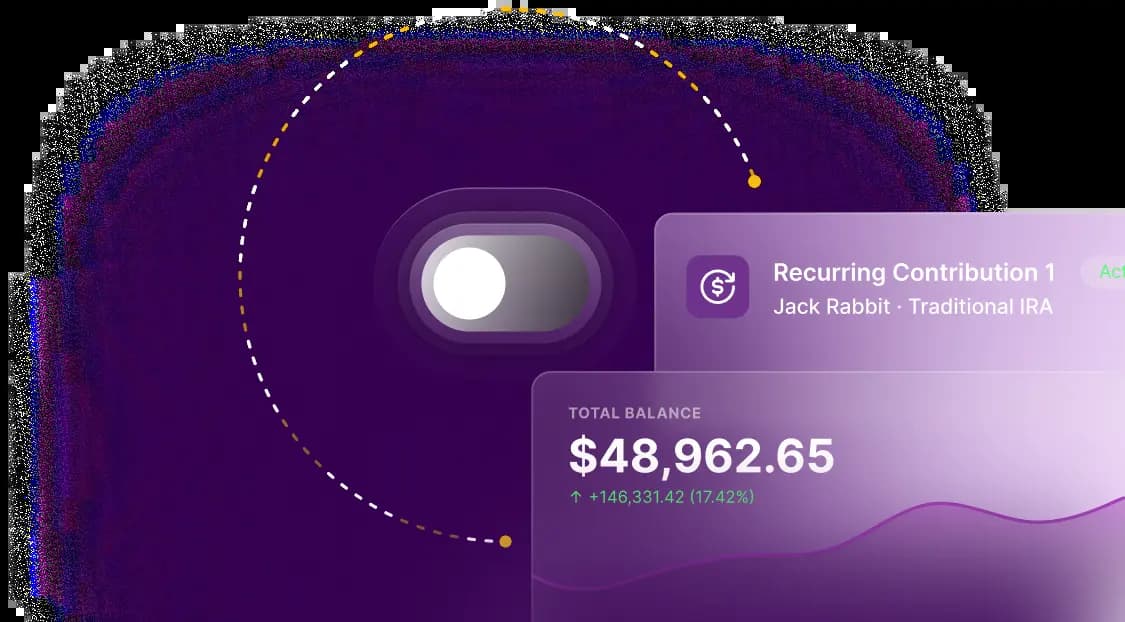
Set up a recurring contribution once. Then never think about it again.
Earning too much for a Roth?
A Traditional IRA has no income cap.
Unlike a Roth IRA, there's no income ceiling that shuts the door on a Traditional IRA. Anyone with earned income can contribute, no workaround required. The only thing that changes at higher incomes is how much of it you get to deduct.
No cap
Income limit to contribute to a Traditional IRA
$83K–$93K
Deduction phase-out, single filers covered by a workplace plan
$133K–$153K
Deduction phase-out, joint filers where the contributing spouse is covered
Full deduction
If neither spouse is covered by a workplace plan, income doesn't matter
Does the deduction phase-out apply to you?
IF YOU'RE NOT COVERED
You get the full deduction
If neither you nor your spouse has a workplace retirement plan, your Traditional IRA contribution is fully deductible, no matter what you earn.
IF YOU ARE COVERED
Your deduction phases out gradually
If you're an active participant in an employer plan, the deduction shrinks within your income range. Above it, contributions still grow tax-deferred, just without the upfront write-off.
Traditional vs. Roth: Which one fits you?
Both accounts reward you for saving. The right one usually comes down to one question: do you want the tax break now, or later?
Traditional IRA
Best if you expect a lower tax rate in retirement
You take the deduction now, lower your taxable income this year, and pay tax on withdrawals later. A strong fit if you're in a higher bracket today than you expect to be after you stop working.
Roth IRA
Best if you expect a higher tax rate in retirement
You contribute after-tax dollars today and withdraw completely tax-free later. A strong fit if you're early in your career or expect your tax rate to climb over time.
We take care of the admin so you don't have to
From setup to compliance, WealthRabbit runs your Traditional IRA in the background so it just... works.
Fully digital setup
No paperwork, no back-and-forth. Open your account and fund your first contribution in about 14 minutes, start to finish.

Seamless rollover
Roll over an old 401(k) or IRA without lifting a finger. We coordinate directly with your previous provider and keep you posted the whole way.

Flexible contribution options
Contribute on your own terms, weekly, monthly, quarterly, or all at once. Adjust the amount any time your plans change.

Simple, live dashboard
Track your balance, growth, and contributions in one place, updated in real time so you always know where you stand.

Set up your Traditional IRA
in Minutes
Set up your account, choose your contribution frequency, and let WealthRabbit handle the rest, all from one streamlined digital platform.



Start planning today with a free Traditional IRA account
One plan. Everything included. No hidden fees.
Traditional IRA
Tax-free growth and withdrawals
No setup or monthly fees
What you will get
- Easy setup in minutes
- No account setup fee
- Access to a wide range of investment options
What you will get
- Easy setup in minutes
- No account setup fee
- Access to a wide range of investment options
Trusted by Businesses,
Accountants & Individuals
Small business owners, freelancers, and CPAs across the country rely on WealthRabbit for their team's retirement future.



Testimonials describe experiences with our software. They don't reflect investment performance or endorse any portfolio strategy.
Frequently asked questions
A Traditional IRA is an individual retirement account that you open on your own, with no employer required. Contributions may be tax deductible, your investments grow tax-deferred, and you pay income tax when you withdraw in retirement. You need earned income to contribute, and anyone with earned income can open one regardless of how much they make.
The 2027 limit is $7,500, or $8,600 if you are age 50 or older, thanks to a $1,100 catch-up contribution. This is a combined limit across all your Traditional and Roth IRAs, so you cannot contribute $7,500 to each. You also cannot contribute more than your taxable earned income for the year.
It depends on whether you or your spouse is covered by a workplace retirement plan. If neither of you is covered, your contribution is fully deductible at any income. If you are covered, the deduction phases out for 2027 between $83,000 and $93,000 of modified AGI for single filers, and between $133,000 and $153,000 for joint filers. If you are not covered but your spouse is, the phase-out range is $250,000 to $260,000. Contributions you cannot deduct can still be made.
Yes. Having a 401(k) does not stop you from contributing to a Traditional IRA. It only affects whether your contribution is deductible, based on your income. There is no income limit for making a Traditional IRA contribution, so high earners can contribute even when the deduction is reduced or unavailable.
A Traditional IRA may suit you if you want a tax deduction now and expect to be in a lower tax bracket in retirement. A Roth IRA may suit you if you expect higher taxes later, since qualified withdrawals are tax-free. Roth eligibility phases out between $158,000 and $173,000 for single filers in 2027, while Traditional has no income cap on contributing.
Traditional IRA withdrawals are taxed as ordinary income. Withdrawals before age 59½ generally also trigger a 10% additional tax. Exceptions include a first-time home purchase (up to $10,000 lifetime), qualified higher education costs, disability, certain medical expenses, and a birth or adoption. Penalty-free withdrawals can still be taxable.
RMDs from a Traditional IRA begin at age 73, or age 75 if you were born in 1960 or later. Each year you must withdraw a minimum amount based on your account balance and life expectancy, and the withdrawal is taxed as income. Missing an RMD can trigger an excise tax on the amount you failed to take.
You can make 2026 Traditional IRA contributions until the tax filing deadline, which is April 15, 2027 for most people. Extensions do not extend the IRA contribution deadline. When you contribute early in 2027, make sure the deposit is labeled for the 2026 tax year. WealthRabbit’s recurring contributions can spread your savings across the year automatically.
Yes. You open a Traditional IRA yourself, so self-employed people, freelancers, gig workers, and employees without a workplace plan can all use one. You only need earned income, such as wages, self-employment income, or alimony from a pre-2019 agreement. There is no maximum age to contribute as long as you have earned income.
Yes, you can have both, but your total contributions across the two cannot exceed the annual limit of $7,500 ($8,600 if 50 or older) in 2027. You can split that amount any way you like, for example $4,000 to Traditional and $3,500 to Roth, as long as you meet the income rules for the Roth portion.
Yes. A direct rollover moves pre-tax 401(k) savings into a Traditional IRA with no tax or 10% penalty when it is done correctly. Rolling over consolidates old accounts and may widen your investment choices. WealthRabbit coordinates with your previous provider to make the transfer easier. Roth 401(k) balances should generally go into a Roth IRA instead.
A spousal IRA lets a spouse with little or no earned income contribute to their own IRA based on the other spouse’s earnings. You must file a joint tax return. Each spouse can contribute up to $7,500 in 2027 ($8,600 if 50 or older), as long as the couple’s combined taxable compensation covers both contributions.

Retirement planning that supports your success
Join hundreds of small businesses and individuals building real financial security with
WealthRabbit - fully digital, fully automated, fully yours.