Contents
- Roth IRA contributions can be withdrawn at any time, for any reason, completely tax- and penalty-free, this is what makes the emergency-fund strategy possible.
- Earnings are treated differently: withdrawing them before age 59½ and before the account is 5 years old triggers income tax plus a 10% early withdrawal penalty.
- Once you withdraw contributions, you cannot recontribute that amount later, the lost tax-advantaged space and compounding time are gone permanently.
- Roth IRAs have no required minimum distributions during the owner's lifetime, unlike Traditional IRAs.
- This strategy fits people with an already-established Roth balance, stable income, and the discipline to track contributions vs. earnings, it's a poor fit for someone just starting out.
- A layered approach works better than relying on the Roth alone: keep 1–2 months of expenses in a high-yield savings account first, use the Roth as a second-tier reserve, and track contribution basis carefully (Form 5498 or custodian records).
Let's be honest: building a fully funded emergency fund AND maxing out your retirement accounts at the same time is hard. Money is tight for most people, and it can feel like you're being forced to choose between protecting yourself today and protecting your future self.
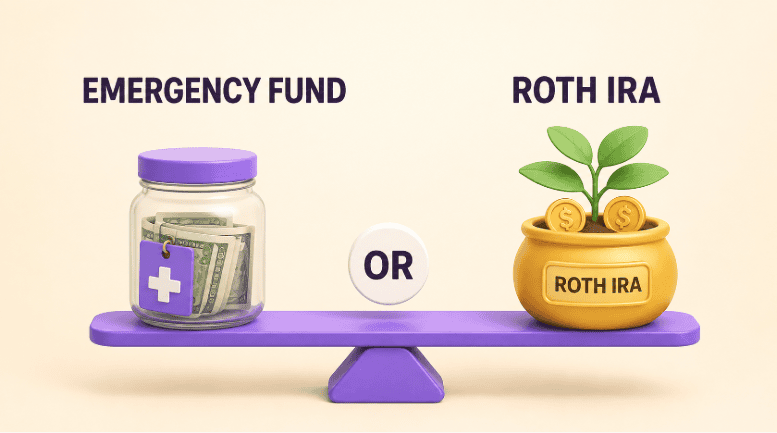
That's why a lot of savvy savers have started looking at a creative workaround: using a Roth IRA as a dual-purpose account that functions as both a retirement vehicle and an emergency cushion. The idea is genuinely clever, but it comes with real trade-offs worth understanding before you go all in.
So, is this strategy a financial power move or a risky shortcut? Let's break it all down.
The Rule That Makes This Strategy Possible
Here is the key detail that makes the Roth IRA-as-emergency-fund idea work at all: you can withdraw your contributions at any time, for any reason, completely tax-free and penalty-free.
That's not a loophole. That's just how Roth IRAs work. Because you already paid taxes on the money before contributing it, the IRS has no claim on it when you take it back out. No waiting until age 59 and a half. No special circumstances required. No paperwork nightmare.
The critical distinction to understand here is contributions versus earnings:
Contributions are the actual dollars you put into the account. These are always yours to take back out without penalty.
Earnings are the investment growth your contributions generate. These come with strings attached. If you withdraw earnings before age 59 and a half and before the account has been open for at least five years, those earnings are typically subject to income tax plus a 10% early withdrawal penalty.
The IRS also has a specific ordering rule in your favor: when you withdraw from a Roth IRA, contributions always come out first, before any earnings are touched. So as long as you are only pulling out an amount equal to or less than what you have contributed, you are completely in the clear.
The Case For Using a Roth IRA as an Emergency Fund
You Get Double Duty From the Same Dollar
This is the heart of the strategy. Instead of keeping money stagnant in a traditional savings account just in case, your dollars sit in a Roth IRA where they can grow tax-free. If you never need to tap into them for an emergency, they become retirement savings. If life throws you a curveball, you have the option to access your contributions. Either way, the money is working for you.
Your Contributions Keep Growing Until You Need Them
A high-yield savings account is great, but it is not growing the way a well-invested Roth IRA can over time. Even a few years of compound growth make a real difference. If you go five or ten years without a major emergency, that "emergency fund" could have grown substantially compared to what it would have earned sitting in cash.
No Required Minimum Distributions
Unlike Traditional IRAs, Roth IRAs have no required minimum distributions during your lifetime. That means if you never need your emergency money, it just keeps growing without the government forcing you to pull it out at a certain age.
One Less Account to Manage
For people who struggle to juggle multiple financial accounts, combining emergency savings and retirement savings into one account simplifies the picture. Fewer accounts means fewer decisions and less mental overhead.
Higher Contribution Limits Than a Standard Savings Product
At $7,500 per year for those under 50, the Roth IRA gives you a meaningful amount of tax-advantaged space to build up over time. After just a few years of consistent contributions, you could have a solid cushion sitting in that account.
The Risks You Cannot Ignore
You Can Never Get Those Retirement Years Back
Every dollar you pull out stops compounding for your future, and that tax-advantaged space is gone permanently. You cannot re-contribute the withdrawn amount on top of your regular annual limit. That lost compounding time is a cost that is easy to underestimate at the moment.
The Account Needs Time to Build Up
This strategy only works if you have years of contributions behind you. If you are relatively new to a Roth IRA, your accessible balance may not be anywhere near enough to cover a real emergency like a job loss or a major medical bill.
Earnings Are Still Off-Limits (Without Penalty)
Only your contributions are penalty-free. If your emergency exceeds what you have contributed, pulling from earnings before age 59 and a half means income taxes plus a 10% penalty on that portion. That is an expensive way to access your own money.
Market Timing Risk
If the market is down when your emergency hits, your Roth IRA balance could be significantly less than what you put in. A traditional savings account never loses value overnight. Your emergency fund needs to be reliable, not dependent on market conditions.
You Cannot Simply Replenish What You Withdrew
This is the con most people never see coming. With a high-yield savings account, you can replace $20,000 as fast as you can save it. A Roth IRA does not work that way. The original contribution still counts against the year it was made, and you are capped at $7,500 per year going forward. Pull out $25,000 in an emergency and it will take more than three years just to get back to where you started, all while that money sits outside the account not growing tax-free.
Withdrawals Are Not Instant
A Roth IRA is not a checking account. Accessing your money means selling investments, waiting for trades to settle, and waiting for a bank transfer, a process that can take three to five business days. If you need cash today for an ER visit or a broken-down car, that delay is a real problem. A small liquid buffer elsewhere is essential if the Roth is your emergency backstop.
Who Is This Strategy Best Suited For?
The Roth-IRA-as-emergency-fund approach makes the most sense for people who:
- Have already been contributing to a Roth IRA for several years and have a meaningful contribution balance built up
- Are disciplined enough to only access the account in genuine emergencies
- Understand the contributions versus earnings distinction clearly and can track what they have put in
- Are in an income range that allows full Roth IRA contributions
- Have relatively stable employment and are not at high risk of a major income disruption in the near term
- Invest the "emergency portion" of their Roth conservatively to avoid market timing risk
It is a much riskier fit for people who are just starting out, have unstable income, or may need to dip into the account frequently.
A Practical Approach: The Layered Strategy
If this idea appeals to you, consider a layered approach rather than going all-in on using the Roth as your only emergency fund:
- Keep one to two months of expenses in a traditional high-yield savings account. This is your first line of defense and should be completely liquid with zero investment risk.
- Use the Roth IRA as your second layer. Think of this as your extended emergency reserve. The contributions are accessible if things get truly serious, but the friction of logging into a brokerage account (versus a regular bank) adds a natural barrier against impulsive withdrawals.
- Keep track of your contributions carefully. The IRS does not automatically know how much of your Roth withdrawal is contributions versus earnings. You need to track this yourself, typically using Form 5498 from your custodian or your own records. This is non-negotiable if you want to withdraw without triggering taxes or penalties.
Final Thoughts
Using a Roth IRA as an emergency fund is not a bad idea. But it is not a replacement for a real emergency fund either.
The strategy works best as a supplement to your emergency savings, not a substitute. The flexibility of Roth IRA contribution withdrawals is a genuinely useful feature, and smart savers can absolutely take advantage of it. But the risks are real, especially the permanent loss of tax-advantaged retirement space, market timing exposure, and the temptation to treat retirement savings as spending money.
If you go into it with clear eyes, track your contributions carefully, invest the "emergency" portion conservatively, and treat the account with the same discipline you would apply to any retirement account, it can absolutely be a smart dual-purpose tool.
Just do not let flexibility become an excuse to underinvest in your financial safety net.
This post is for informational purposes only and does not constitute financial or tax advice. Consult a qualified financial advisor or tax professional before making decisions about your retirement accounts.
FAQs
About the Author

Not sure which plan fits?
Answer three quick questions about team size and budget - we'll match you to a plan, no reading required.