Contents
If you didn't get your IRA contribution in before the deadline, you're in good company. A lot of people meant to and didn't, whether life got in the way, cash was tight in March, or the date just slipped past.
The contribution itself is gone for that tax year, and there's no way around that. But the bigger picture hasn't changed. You still have decades of contributions ahead of you, and the next one starts now.
What does missing the deadline actually cost you
Be straight with yourself about what happened. You lost one year of contribution room, up to $7,000 (or $8,000 if you're 50 or older). Over a 30-year horizon at a 7% average return, that single missed year works out to roughly $53,000 in foregone growth. It's not nothing, but it's also not a reason to give up on the strategy.
What you didn't lose:
- Your eligibility going forward
- Your ability to contribute for the current tax year, which you can start on right now
- Any contributions you've already made in prior years
The mistake to avoid is letting one missed year turn into two. That's where the real cost shows up.
Know Your 2026 Contribution Limits Before You Restart
Before you start contributing again, it’s important to align your plan with the 2026 IRS contribution limits.
For the 2026 tax year:
- Traditional IRA and Roth IRA contribution limit: $7,500
- Catch-up contribution (age 50 and above): $8,600
- Roth IRA income eligibility limits:
- Single filers: Up to $150,000 (phase-out begins)
- Married filing jointly: Up to $236,000 (phase-out begins)
If your income exceeds the Roth eligibility range, a Backdoor Roth strategy may still allow you to contribute indirectly.
Start the next year now, not next March
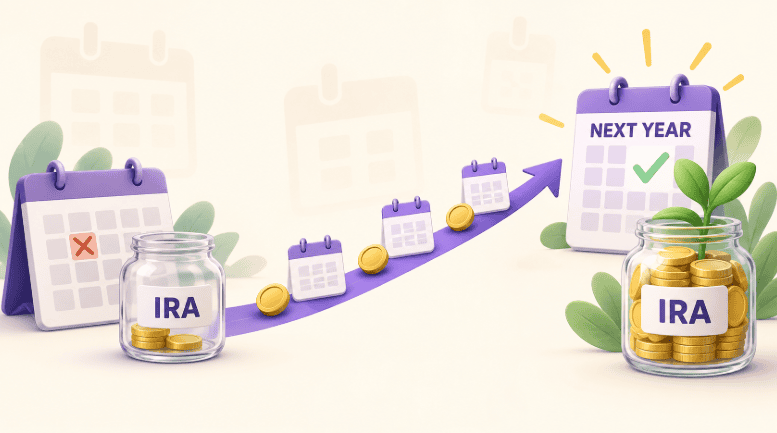
The single biggest shift you can make is moving from a deadline-driven habit to a calendar-driven one. People who max out their IRA every year almost never do it in April. They do it in small pieces throughout the year, or in one move early in January when they have clarity on their income.
Starting early gives you a few real advantages:
- Time in the market. A contribution made in January 2026 has 15 extra months of growth compared to one made in April 2027 for the same tax year. Compounded over a career, that gap matters.
- Dollar-cost averaging. Spreading contributions across the year smooths out the price you pay for investments. You're not making a lump-sum bet on whatever the market happens to be doing on April 14.
- Cash flow flexibility. Pulling $7,500 out of your account in one shot is harder than setting aside about $625 a month. The monthly version is easier to sustain.
- Room to course-correct. If your income changes mid-year and pushes you near a Roth phase-out, you have time to adjust. If you wait until the deadline, you're locked into whatever the situation is at that moment.
Pick your IRA before you fund it
A common mistake is treating the IRA decision as a formality and defaulting to whichever account you opened first. Your situation may have changed since then. Take a fresh look.
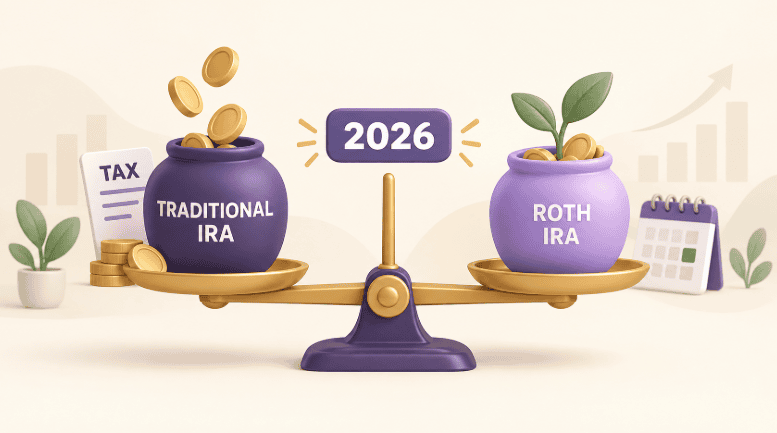
Traditional IRA. Useful if you want to lower your taxable income for the current year and you expect to be in a lower tax bracket in retirement. Worth a closer look if your income is high right now and you anticipate stepping back from full-time work later.
Roth IRA. Useful if you'd rather pay taxes now and take withdrawals tax-free in retirement. Often, the better fit earlier in your career, when your tax bracket is likely lower than it will be later. Roth contributions also give you more flexibility, since you can withdraw your contributions (not earnings) at any time without penalty.
Backdoor Roth IRA. Relevant if your income is above the Roth contribution limits ($150,000 for single filers, $236,000 for joint filers in 2026). You contribute to a Traditional IRA on a non-deductible basis and then convert to a Roth. The pro-rata rule can complicate this if you have other Traditional IRA balances.
If you're unsure between Traditional and Roth, the rough rule of thumb is simple. If your tax rate today is higher than what you expect in retirement, lean to Traditional. If it's lower, lean to Roth. If the two look similar, Roth tends to win on flexibility.
Still unsure? Use the IRA calculator to compare both options based on your income and tax outlook.
A simple plan for the year ahead
You don't need anything elaborate. A working plan looks like this:
- Pick your target. Decide whether you're aiming for the full ($7,500 or $8,600 if you're 50+ for 2026) or a smaller number that fits your budget.Write it down.
- Divide by 12. Set up an automatic monthly transfer. About $625/month gets you the full contribution.
- Pick a check-in cadence. Once a quarter, look at where you are. Adjust up or down based on bonuses, raises, or unexpected expenses.
- Confirm the tax year on every contribution. This is the step people forget. Make sure each contribution is designated for the year you intend, not the one the system defaults to.
- Reassess in November. Before year-end, look at your income, your tax situation, and any room left. If you have catching up to do, this is when to do it.
That's the entire plan. It's not complicated. The hard part is starting.
The mistakes worth not repeating
Most missed contributions come down to the same handful of issues:
- Waiting until April and assuming there'll be time
- Losing track of how much has already been contributed across multiple accounts
- Designating a contribution for the wrong tax year and not catching it
- Believing a tax filing extension also extends the IRA deadline (it doesn't)
- Going over the limit by contributing to both a Traditional and a Roth without realizing the $7,500 combined cap (2026)
Automating contributions removes most of these. So does using a single platform where you can see all your accounts and contribution status in one view.
How WealthRabbit fits in
WealthRabbit is built around the idea that retirement savings shouldn't depend on whether you remember a deadline. Once your account is set up, the system handles the rest.
You can manage Traditional, Roth, and backdoor Roth accounts in one place, set up recurring contributions on whatever cadence works for your cash flow, and track exactly where you stand against your annual limit at any point in the year. The contribution year is clearly designated on every transfer, so there's no guessing whether something landed in the right bucket.
If you missed this year, the most useful thing you can do today is open or log back into your account, set a target for the current tax year, and turn on a monthly contribution. Twenty minutes of work, then it runs on its own.
The next 12 months are an opportunity
Last year's window was closed. The current one is wide open, and you have the full year to use it well instead of scrambling at the end. Set the plan up once, let it run, and you won't be reading a "missed the deadline" article next April.
This content is for informational purposes only and does not constitute tax or financial advice. Contribution limits, income thresholds, and eligibility requirements are based on IRS guidelines. Consult a qualified tax advisor or financial professional before making decisions.
About the Author

Not sure which plan fits?
Answer three quick questions about team size and budget - we'll match you to a plan, no reading required.