Contents
- SECURE 2.0 allows (but doesn't require) SEP plans to offer a Roth option for participants, effective for tax years starting after December 31, 2022.
- Contribution limits are identical whether the SEP contribution goes to a traditional or Roth account: the lesser of 25% of compensation or $72,000 for 2026, on compensation up to $360,000.
- With Roth SEP, the contribution is included in the participant's taxable income for the year it's deposited — but qualified withdrawals, including earnings, are tax-free later.
- Employers must decide whether to offer the Roth option at all; if they do, each participant elects it individually, and the election must be documented before funds are deposited.
- Roth SEP contributions are not subject to required minimum distributions during the original owner's lifetime, unlike traditional SEP.
A SEP IRA has long been a practical retirement plan for self-employed individuals and small business owners. It offers flexible employer contributions, relatively simple administration, and the potential to save significantly more than with a standard IRA.
Traditionally, SEP contributions followed one tax path: receive the potential tax benefit today and pay income tax when the money is withdrawn in retirement.
SECURE 2.0 created another option.
Employers may now allow SEP contributions to be made to a Roth IRA. This option commonly called a Roth SEP IRA, lets participants pay income tax on the contribution now while creating the potential for tax-free qualified withdrawals in retirement. The provision applies to taxable years beginning after December 31, 2022.
WealthRabbit now supports Roth SEP contributions, giving eligible business owners greater flexibility over how their SEP savings are taxed.
What is a Roth SEP IRA?
A Roth SEP IRA is not an entirely new type of retirement plan. It is a Roth IRA designated to receive contributions made through an employer’s SEP arrangement.
The SEP plan continues to determine:
- Who is eligible to participate
- How much the employer contributes
- When contributions are made
- How contributions are allocated among eligible participants
What changes is the participant’s tax treatment.
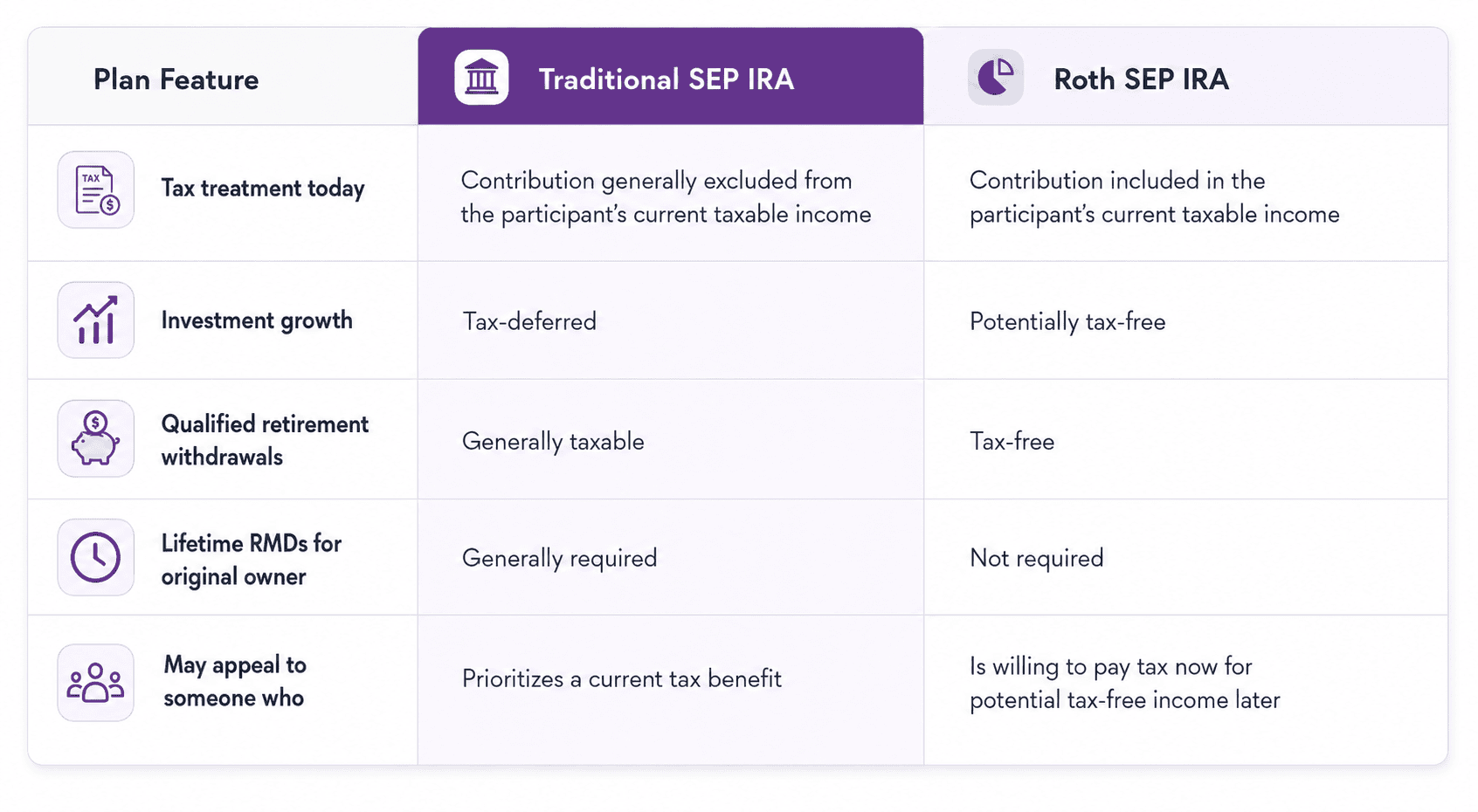
With a traditional SEP IRA, eligible contributions are generally excluded from the participant’s current taxable income, and withdrawals are generally taxed later.
With a Roth SEP IRA, the contribution is included in the participant’s taxable income when it is deposited. In return, qualified withdrawals—including eligible earnings, may be received tax-free. Roth IRA owners are also not required to take required minimum distributions during their lifetime.
What changed under SECURE 2.0?
Before SECURE 2.0, SEP contributions generally had to be deposited into traditional SEP IRAs.
SECURE 2.0 allows an employer maintaining a SEP arrangement to offer participants the option to designate a Roth IRA as the account receiving SEP contributions.
However, offering Roth treatment is optional. An employer may continue to offer only traditional SEP IRAs.
When the Roth option is available, the participant must affirmatively elect it before the contribution is made. The employer cannot automatically direct a participant’s contribution to a Roth SEP IRA.
This makes the contribution process especially important. The tax election should be clearly documented before funds are deposited.
With WealthRabbit, eligible users can manage their SEP plan and choose the supported tax treatment for their contributions through a guided digital experience.
How much can you contribute to a Roth SEP IRA?
Roth SEP contributions use the regular SEP contribution limits—not the standard personal Roth IRA contribution limit.
For 2026, the maximum SEP contribution for a participant is generally the lesser of:
- 25% of eligible compensation, or
- $72,000
The maximum compensation that may be considered for 2026 is $360,000. Self-employed individuals must use a special calculation based on adjusted net earnings from self-employment.
A standard SEP generally accepts employer contributions rather than employee salary deferrals. The employer also is not required to contribute every year. However, when an employer contributes, the SEP’s allocation rules must be followed for all eligible employees.
A simple example
Suppose your business makes a $30,000 SEP contribution for you.
With a traditional SEP IRA, the contribution is generally not included in your current taxable income. You would generally pay income tax when you withdraw the money.
With a Roth SEP IRA, the $30,000 is included in your taxable income for the year it is deposited. If the applicable Roth IRA requirements are later satisfied, qualified withdrawals may be tax-free.
The amount contributed has not changed. The difference is when you pay income tax.
Traditional or Roth: Which SEP option may fit you?
Neither option is automatically better. The right choice depends on your current tax situation, expected future income, available cash, and retirement goals.
A Roth SEP IRA may be worth considering when:
- You expect your tax rate to be higher in the future.
- You have many years before retirement.
- You want both traditional and Roth assets for greater tax flexibility.
- You prefer not to take lifetime RMDs from the Roth account.
- You have enough cash outside the retirement account to cover the current tax.
A traditional SEP IRA may remain attractive when:
- Reducing current taxable income is a priority.
- Your business had a particularly profitable year.
- You expect to be in a lower tax bracket during retirement.
- Paying the tax on a large Roth contribution would strain your cash flow.
Because the Roth contribution is included in income but generally is not subject to federal income tax withholding, a participant may need to adjust other withholding or make estimated tax payments.
Why Roth SEP contributions require careful planning
The ability to contribute a significant amount to a Roth account can be valuable, but it can also create a substantial current-year tax obligation.
For example, directing a $50,000 SEP contribution to a Roth SEP IRA may add $50,000 to the participant’s gross income for the year the money is deposited.
The contribution may relate to the employer’s prior tax year, but Roth income recognition generally occurs in the participant’s tax year in which the contribution reaches the Roth IRA.
Before selecting Roth treatment, consider:
- Your estimated marginal tax rate
- Whether the contribution could affect other income-based tax provisions
- How you will pay the resulting tax
- Your expected retirement tax rate
- How long the contribution will remain invested
A tax professional can help you compare the immediate tax cost with the potential long-term benefit.
Your SEP now offers more than one tax path
SECURE 2.0 gives eligible SEP participants a choice that did not previously exist: receive the potential tax benefit now through a traditional SEP IRA or pay tax today to pursue tax-free qualified retirement income through a Roth SEP IRA.
The right answer will not be the same for every business owner. But having a choice makes it possible to build a retirement strategy that better reflects your income, tax outlook, and long-term goals.
With Roth SEP support from WealthRabbit, you can manage that choice and your contributions through one organized digital experience.
Start building a more flexible SEP strategy with WealthRabbit.
This content is provided for general educational purposes and does not constitute tax, legal, or investment advice. Eligibility, contribution limits, tax treatment, and Roth SEP availability depend on the applicable plan, provider, and individual circumstances. Consult a qualified professional before making a retirement contribution or tax election.
FAQs
About the Author

Not sure which plan fits?
Answer three quick questions about team size and budget - we'll match you to a plan, no reading required.