Contents
- What is the year-end retirement checklist for a small business?
- How do I start a SIMPLE IRA for January 1, 2027?
- Can I still lower my 2026 taxes with a retirement plan?
- What should I check if I already have a plan?
- What tax credits cover the cost of starting a plan?
- Is a SIMPLE IRA cheaper than a 401(k)?
- When is a SIMPLE IRA not the right choice?
- Five mistakes that cost small business owners the most
- Your one-page checklist
- The bottom line
- FAQs
- Article Sources
- Two clocks are running. One decides your 2026 tax bill. The other decides whether your team has a plan on January 1, 2027. Different moves beat different clocks.
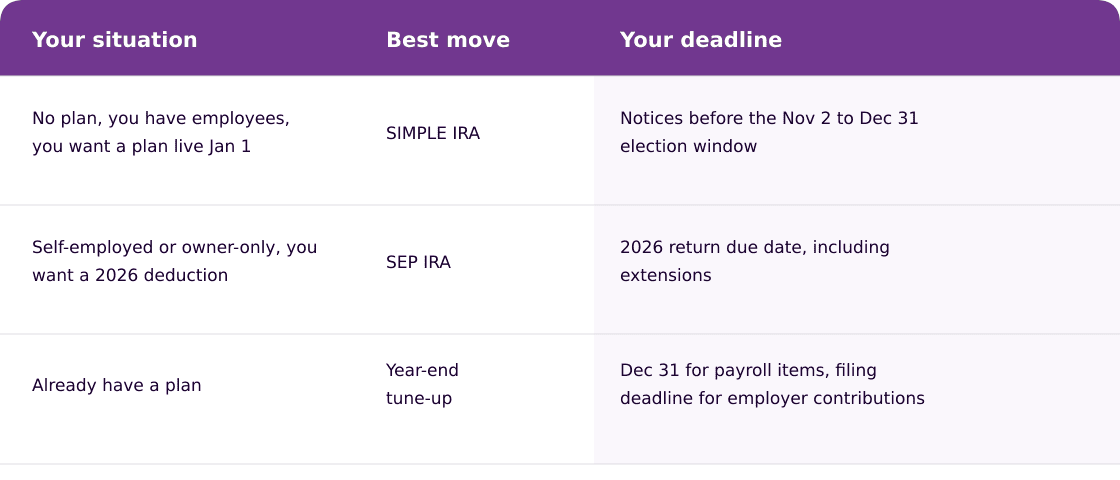
- The SIMPLE IRA election window opens November 2, 2026. The Department of Labor and the IRS both describe the annual 60-day election period as running November 2 to December 31, and employers must give employees their notice before it starts.
- A SIMPLE IRA started in 2027 will not cut your 2026 taxes. A SEP IRA can, and you have until your 2026 tax return due date, including extensions, to open and fund it.
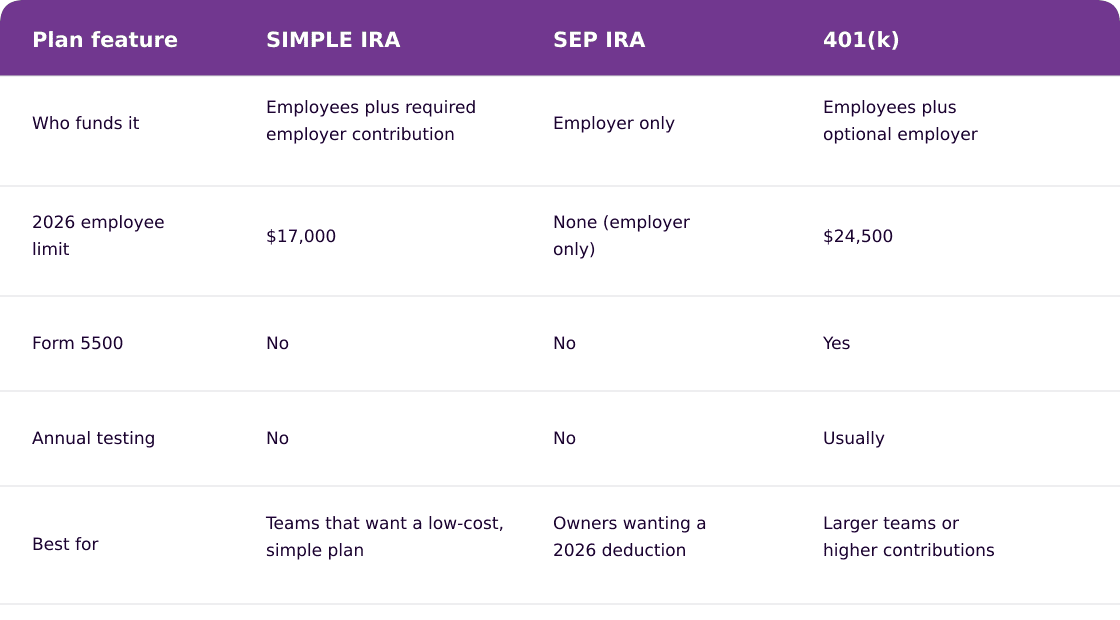
- 2026 limits: The IRS sets SIMPLE IRA deferrals at $17,000 (plus a $4,000 catch-up at 50+ and $5,250 at ages 60 to 63). The SEP cap is the lesser of 25% of pay or $72,000.
- Startup credits can offset the cost of the plan. Eligible small employers can claim up to $5,000 a year for three years, limited to actual setup and admin costs.
- A SIMPLE IRA is not right for everyone. It requires an employer contribution every year, and its limits are lower than a 401(k)’s.
It is early November, and “set up a retirement plan” has been sitting near the bottom of your list since spring. It is worth moving up, because the deadlines that matter are in the next eight weeks.
What is the year-end retirement checklist for a small business?
Pick your track (a plan for January 1, a 2026 deduction, or both), send required employee notices, make sure payroll deferrals and employer contributions are on time, and claim startup credits. Here is how the three tracks compare:
How do I start a SIMPLE IRA for January 1, 2027?
Adopt the plan, then give each eligible employee a summary description and election notice before November 2. Employees then have November 2 to December 31 to decide whether to contribute.
A SIMPLE IRA (Savings Incentive Match Plan for Employees) is a retirement plan for employers with 100 or fewer employees who earned $5,000 or more last year, according to the Department of Labor. The timeline:
- Now: Adopt the plan and choose where the accounts will live.
- Before Nov 2: Give eligible employees the plan summary and the notice that they can start contributing.
- Nov 2 to Dec 31: Employees choose whether to contribute and how much.
- Jan 1: The plan is live, and the first payroll deferrals begin.
Missed the notice date? The IRS publishes a correction path for employers who did not give the annual notice on time, and it generally involves giving the notice and offering an extended election period. The IRS can also assess penalties for missed notices, so fix it quickly and talk to your tax professional.
What you owe your employees. Every year you sponsor a SIMPLE IRA, the Department of Labor says you must contribute either:
- A match of up to 3% of pay for employees who contribute (in some years as low as 1%, with advance notice), or
- 2% of pay for every eligible employee, whether they contribute or not.
An employee earning $50,000 who defers 6% puts in $3,000, and a 3% match costs you $1,500. That match is deductible.
Limits. For 2026, the IRS allows employee deferrals of up to $17,000, with a $4,000 catch-up at 50 and older and $5,250 at ages 60 to 63. Your plan will run on 2027 limits, which the IRS typically announces in the fall, so confirm them before you set up payroll.
Can I still lower my 2026 taxes with a retirement plan?
Yes. A SEP IRA can be opened and funded for 2026 up to your 2026 tax return due date, including extensions, according to IRS guidance.
A SIMPLE IRA started in 2027 cannot be deducted on your 2026 return, so a SEP is the tool for this year’s bill. A SEP (Simplified Employee Pension) is funded entirely by the employer. The 2026 cap is the lesser of 25% of compensation or $72,000.
A number most articles skip. For a self-employed owner, the effective rate is closer to 20% of net earnings, not 25%, because of how the calculation works after the self-employment tax deduction. IRS Publication 560 walks through the worksheet.
A sole proprietor who nets $120,000 can contribute roughly $22,000. At a 24% federal bracket, that is about $5,300 less federal tax. Your CPA can run your exact numbers.
Two cautions:
- A SEP must cover your eligible employees at the same percentage you give yourself. Price this out before you commit if you have a team.
- A Roth SEP is allowed under SECURE 2.0 and has no income limit like a Roth IRA, but it gives up the deduction, and not every provider offers it yet.
What should I check if I already have a plan?
Deposit deferrals on time, total your 2026 employer contribution, check new-hire eligibility, and review catch-up ages.
- Deposit employee deferrals promptly. For SIMPLE IRAs, the outside limit is 30 days after the end of the month the money was withheld and sooner is better.
- Total your 2026 employer contribution (match or 2% nonelective). You generally have until your tax filing deadline to fund it.
- Check new hires who may have crossed the $5,000 pay threshold.
- Flag catch-up eligibility for employees turning 50 or reaching 60 to 63.
What tax credits cover the cost of starting a plan?
Two credits can apply. The startup credit is up to $5,000 a year for three years, and the employer contribution credit is up to $1,000 per employee earning $100,000 or less, under SECURE 2.0 and IRS guidance.
- Startup credit: Covers ordinary setup and administration costs. Employers with 50 or fewer employees can generally cover 100% of those costs, and employers with 51 to 100 employees can cover 50%.
- Employer contribution credit: Phases down over five years, with the full amount for employers with 50 or fewer employees.
The startup credit cannot exceed what you actually spend, so with a low-cost plan it can cover most or all of your fees, but not more. And you claim it on Form 8881 with your return, so keep your invoices.
Is a SIMPLE IRA cheaper than a 401(k)?
Usually yes for teams of 100 or fewer. A SIMPLE IRA has no Form 5500 filing and no annual nondiscrimination testing, which are two of the main cost drivers of a 401(k). WealthRabbit’s SIMPLE IRA is $29 a month plus $4 per employee.
When is a SIMPLE IRA not the right choice?
When you are a solo owner, a high earner who wants to contribute much more than $17,000, or cannot absorb the required employer contribution every year.
- Solo owner: A solo 401(k) can allow far higher contributions at the same income.
- High earner: SIMPLE limits are lower than 401(k) limits.
- Tight budget: The employer contribution is mandatory each year you have the plan.
If any of these sound like you, a quick conversation with a tax professional is worth more than any checklist.
Five mistakes that cost small business owners the most
- Waiting for January. The SIMPLE window and most year-end deductions close before then.
- Choosing a plan for the tax break alone and skipping the employee contribution rules.
- Forgetting a SEP covers your team too.
- Letting payroll deferrals sit before depositing them.
- Skipping the credits because Form 8881 looked intimidating.
Your one-page checklist
- Decide your track: January 1 team plan, 2026 deduction, or both
- If starting a SIMPLE IRA, adopt the plan and send employee notices now
- If you want a SEP deduction, ask your CPA to estimate the amount and note your filing deadline
- Deposit all 2026 employee deferrals on time
- Total your 2026 employer contribution
- Review new-hire eligibility and catch-up ages
- Save setup and admin invoices for the startup credit (Form 8881)
- Confirm 2027 contribution limits once the IRS publishes them
The bottom line
You do not need to become a retirement expert by December 31. You need to know which clock you are on, make one or two decisions, and put the dates in your calendar.
Want to see your numbers? WealthRabbit sets up a SIMPLE IRA in about 10 minutes and handles the employee notices. See your savings or talk to us and we will walk you through it.
This article is for general education and is not tax or legal advice. Retirement account rules are detailed and change over time, and every situation is different. Please talk with a qualified tax professional about your specific circumstances before moving retirement funds
FAQs
About the Author

Not sure which plan fits?
Answer three quick questions about team size and budget - we'll match you to a plan, no reading required.