Contents
- Why the SIMPLE IRA is the easy recommendation
- A built-in reason to start the conversation: state mandates
- The tax credits your clients may be leaving on the table
- Refer it, do not run it
- A new line for the firm
- What WealthRabbit Offers To your firm
- Which clients to flag, and when
- Where a SIMPLE IRA shows up in your work
- When a SIMPLE IRA is not the right recommendation
- How to start
- FAQs
- Article Sources
Your client just finished a strong year. Over the final review, they ask the question you hear every fall: "Should I start a retirement plan for my team?"
You already know the tax side. A SIMPLE IRA lets you answer well, help the client claim credits they may not know exist, and open a new line for your firm, without becoming an investment advisor.
- Who it fits: Clients with 100 or fewer employees and no other retirement plan.
- What it saves them: No Form 5500, no annual nondiscrimination testing, and a deductible employer contribution.
- for three years for auto-enrollment, and up to $1,000 per employee for employer contributions, all claimed on Form 8881. That is where the "up to $16,500" figure comes from.
- Your role: You refer, you do not advise. WealthRabbit runs setup, compliance, and ongoing administration.
- Your pay: Partner pricing improves automatically with your active client count, from 5% up to 20%, as a discount you can pass along or keep.
- Timing: A first-time plan can start any date from January 1 through October 1. If the client misses that window, January 1 is next.
Why the SIMPLE IRA is the easy recommendation
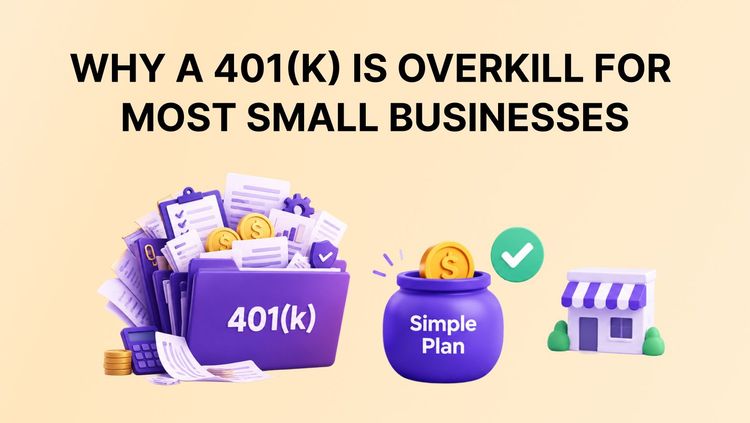
For a client with fewer than 100 employees and no other retirement plan, a SIMPLE IRA usually fits better than a 401(k). It delivers the same tax-advantaged savings with far less cost and paperwork. On WealthRabbit, the employer pays $29 a month plus $4 a month per employee, with no Form 5500 and no annual testing. Employees pay a tiered asset management fee of 0.20% to 0.50% based on balance, plus a $10 annual maintenance fee.
| Category | SIMPLE IRA | 401(k) |
|---|---|---|
| Best for | Businesses with 100 or fewer employees | Larger teams, or owners who want to save more |
| Form 5500 | Not required | Required annually |
| Annual testing | None | Yes, unless safe harbor |
| Employer contribution | Required: 3% match or 2% for all | Optional, or required if safe harbor |
| Vesting | Always 100% | Can be delayed |
| Loans | Not permitted | Allowed if the plan offers them |
| 2026 employee limit | $17,000 ($21,000 with catch-up at 50+) | $24,500 ($32,500 with catch-up at 50+) |
A built-in reason to start the conversation: state mandates
Many states now require employers without a retirement plan to enroll their employees in a state-run program. A SIMPLE IRA lets a client meet that requirement with a plan of their own, and the plan can include an employer contribution that state programs do not allow.
California is a good example. Employers that sponsor a SIMPLE IRA do not have to register with CalSavers, though they still need to certify their exemption. Details vary by state, so check each one. WealthRabbit supports more than 20 state mandates and publishes state-by-state guides, including a SIMPLE IRA vs. CalSavers comparison.
The tax credits your clients may be leaving on the table
Most business owners have never heard of these credits. You get to be the one who tells them. There are three, all claimed on Form 8881:
| Credit | What it covers | How much |
|---|---|---|
| Startup credit | Setting up and administering the plan, and educating employees | 100% of eligible costs for 50 or fewer employees, 50% for 51 to 100. Capped at the greater of $500 or the lesser of $250 per eligible non-highly compensated employee or $5,000. Available for three years. |
| Employer contribution credit | Employer contributions for employees earning $100,000 or less (2023 figure, indexed) | Up to $1,000 per employee. 100% in years one and two, then 75%, 50%, and 25% in years three to five. Reduced for employers with 51 to 100 employees. |
| Auto-enrollment credit | Adding an eligible auto-enrollment feature | $500 a year for three years |
A client with 12 employees, all non-highly compensated, pays about $924 a year in plan fees ($29 plus $4 per employee, each month). Their startup credit cap is $3,000 (12 x $250). If the fees qualify, the credit could offset the full cost in year one.
Two cautions. A client cannot both deduct a startup cost and claim the credit for the same expense. And the maximum is not the typical result, so run the numbers for each client.
Refer it, do not run it
You do not need a Series 65 to recommend WealthRabbit. You refer the client, and WealthRabbit is the investment expert that manages the plan, the platform, and the participants. You stay the trusted advisor without taking on fiduciary or investment responsibility.
It was built by someone who sat in your chair. Co-founder Jason Ackerman, CPA, CFP®, puts it this way: "Clients need retirement plans, and firms need recurring revenue, but the admin made it impossible to say yes."
| Role | WealthRabbit |
|---|---|
| Spot the fit and explain the tax angle | Sets up and runs the plan |
| Flag the credits and the deduction | Manages the platform and the investments |
| Make the introduction | Supports the employer and every participant |
| Handle the tax return | Handles employee enrollment, contributions, and reporting |
One boundary matters. The federal exclusion for accountants covers investment advice that is solely incidental to your accounting practice, and it does not protect an accountant who holds themselves out as an investment adviser. So refer, and leave fund selection and allocation advice to WealthRabbit. If you are unsure where your own line sits, check with your state board or counsel.
A new line for the firm
Referrals earn recurring value for the firm. The more clients you help, the better your partner pricing gets:
| Tier | Active clients | Discount on WealthRabbit software |
|---|---|---|
| Starter | Up to 10 | 5% |
| Growth | 11 to 25 | 10% |
| Pro | 26 to 50 | 15% |
| Elite | 51 or more | 20% |
You can pass the discount along to your client or keep it as revenue share. There are no applications, approvals, or waiting periods, and tiers update automatically based on your active client count, reviewed monthly. Implementation costs $0.
Say your firm has 30 clients averaging 12 employees each. At the rates above, that is about $27,720 a year in software fees. At the Pro tier of 15%, that comes to about $4,158 a year. This is only an example, so use the revenue calculator on WealthRabbit's accounting professionals page to model your own mix.
What WealthRabbit Offers To your firm
- Accountant dashboard: Every client plan, contribution status, and onboarding stage in one place.
- Client reporting and true-up tracking: Contribution reports, plan summaries, and year-end true-up information across clients.
- Team permissions: Add staff, assign client relationships, and control access by role.
- Automated contributions: Connect a client's payroll once, and contributions are calculated and tracked every pay period.
- Karbon sync: Clients, onboarding tasks, and workflows flow into the tool you already use
Which clients to flag, and when
Look for clients who:
- Have fewer than 100 employees and no other retirement plan.
- Have employees who earn $5,000 or more a year.
- Operate in a state with a retirement mandate.
- Are asking about benefits to hire and keep good people.
Timing gives you a natural opening each fall. A first-time SIMPLE IRA can start any date from January 1 through October 1. If the client previously had a SIMPLE IRA, it can only start on January 1. Employees must get notice before the annual election period, which generally runs November 2 to December 31. A client who misses October 1 can simply start on January 1.
Where a SIMPLE IRA shows up in your work
| Item | What to know |
|---|---|
| Employer deduction | Employer contributions are deductible on the business return |
| Deposit deadlines | Employee deferrals within 30 days after the end of the month. Employer match or 2% contribution by the return due date, including extensions. |
| Form W-2 | Deferrals are not in box 1. Check the box 13 retirement plan box. Deferrals are still subject to Social Security, Medicare, and FUTA. |
| Roth option | Under SECURE 2.0, employees can designate a Roth IRA. Employer contributions to a Roth SIMPLE are reported on Form 1099-R. |
| Form 5500 | Generally not required |
| Tax credits | Form 8881 |
When a SIMPLE IRA is not the right recommendation
A good advisor knows when to say no. A SIMPLE IRA may not fit if the client:
- Wants to defer more than the SIMPLE limit. The owner may prefer a 401(k).
- Wants plan loans, which a SIMPLE IRA does not permit.
- Already sponsors another retirement plan, because a SIMPLE IRA generally has to be the only one.
- Cannot commit to the required employer contribution each year.
Remind clients that withdrawals within the first two years of participation can carry a 25 percent additional tax instead of the usual 10 percent.
How to start
The next time a client raises retirement, or you spot one who should, point them to WealthRabbit and make the introduction. Four steps:
- Create your firm account. Set up your profile and dashboard in minutes.
- Invite your team. Assign roles so staff can collaborate securely.
- Launch the plan. Invite the client to complete onboarding, or manage setup on their behalf. The client signs Form 5305-SIMPLE and the agreement, and WealthRabbit creates the IRA account. Then employees enter their details, choose a contribution and investments, and e-sign. Average client onboarding takes under 15 minutes.
- Monitor and earn. Track activity and contributions from one dashboard, with revenue share calculated and paid automatically.
FAQs
- IRS: SIMPLE IRA plan
- IRS: Retirement plans startup costs tax credit
- IRS: Form 8881 (PDF)
- IRS: 401(k) limit increases to $24,500 for 2026 (IR-2025-111)
- IRS: Notice 2025-67 (PDF)
- IRS: Notice 2024-2, SECURE 2.0 guidance including Roth SIMPLE IRAs (PDF)
- WealthRabbit: Pricing
- WealthRabbit: For CPAs and Bookkeepers
About the Author

Not sure which plan fits?
Answer three quick questions about team size and budget - we'll match you to a plan, no reading required.