Contents
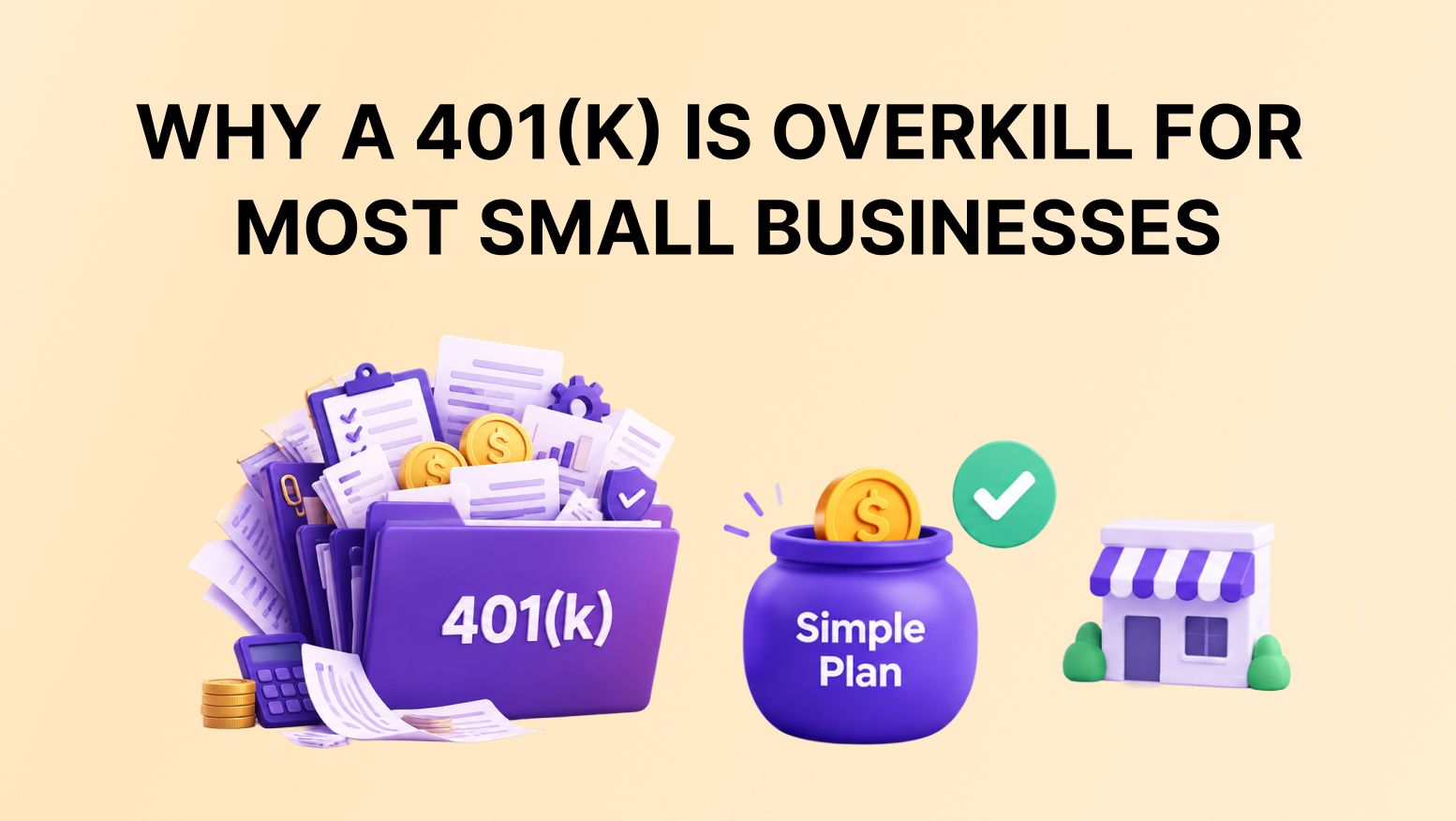
If you run a small business and have been told you need a 401(k) to offer a serious retirement benefit, it is worth stopping to ask whether that is actually true. For most companies with fewer than 100 employees, a 401(k) is overkill.
- Cost: A SIMPLE IRA on WealthRabbit is $29 a month plus $4 per employee. A 20-person company pays about $1,308 a year.
- Paperwork: No Form 5500, no annual nondiscrimination testing and no third-party administrator.
- Match: A SIMPLE IRA match is capped at 3% of pay. A safe harbor 401(k) typically needs the equivalent of about 4%. On a $1,000,000 payroll, that gap can be about $10,000 a year.
- Tax credits: SECURE 2.0 can offset the setup and administration costs of a new plan for up to three years, and it adds a credit for employer contributions at smaller companies.
- Trade-off: Contribution limits are lower than a 401(k), and the SIMPLE IRA has to be your only plan. If you want owners to save much more, a 401(k) may be the right tool.
What a 401(k) really brings
A 401(k) was built for large employers. It typically comes with:
- Annual nondiscrimination testing, which can force highly paid employees to take money back if lower-paid staff do not participate enough
- A Form 5500 filed every year
- A third-party administrator to run the plan
- Layers of investment and recordkeeping fees that come out of employee returns
A company with a full HR and finance team can absorb that. For a business with 15 or 40 employees, it becomes a second job nobody asked for. And since SECURE 2.0, most new 401(k) plans must also enroll eligible employees automatically, which adds design and payroll work of its own. (Very small and brand-new businesses are exempt.)
What most small businesses actually need
Strip the question down and most owners want the same three things:
- A plan employees genuinely value
- A cost that makes sense
- Something that does not eat their time
A SIMPLE IRA delivers all three. It offers tax-advantaged retirement savings with an employer contribution for $29 a month plus $4 per employee, with no Form 5500, no annual testing and no third-party administrator.
SIMPLE IRA vs. 401(k) at a glance
| Category | SIMPLE IRA | 401(k) |
|---|---|---|
| Best for | 100 or fewer employees | Larger teams, or owners who want to save more |
| Employer contribution | Required: 3% match or 2% for all | Optional, or about 3% to 4% if safe harbor |
| Annual testing | None | Yes, unless safe harbor |
| Form 5500 filing | Not required | Required annually |
| Third-party administrator | Not needed | Usually needed |
| Employee deferral limit (2026) | $17,000 | $24,500 |
| Catch-up, age 50+ (2026) | $4,000 | $8,000 |
| Roth option | Yes, under SECURE 2.0 | Yes, if the plan offers it |
| Vesting | Immediate, 100% | Can be delayed |
| Setup effort | About 10 minutes | Often weeks |
| Other plans allowed | No, must be your only plan | Yes |
The match math
Say you run a 20-person company with an average salary of $50,000, so a $1,000,000 payroll.
- SIMPLE IRA: You match up to 3% of pay. If every employee contributes at least 3%, your maximum match is $30,000.
- Safe harbor 401(k): The common match formula is the equivalent of about 4% of pay, so the maximum is $40,000.
- Difference: About $10,000 a year that stays in your business, while your team still gets a real retirement benefit.
That is the ceiling. If only some employees contribute, your actual match cost is lower under both plans. The gap in the formulas is what matters. Add the platform cost (about $1,308 a year for this company) and the total is often less than the extra match a 401(k) would require.
The tax credits
SECURE 2.0 makes starting a plan cheaper in two ways:
- Startup credit: Employers with up to 50 employees can generally claim 100% of eligible setup and administration costs, up to $5,000 a year for the first three years. Employers with 51 to 100 employees can claim 50%. You generally cannot have offered a plan in the previous three years.
- Employer contribution credit: Smaller employers can also claim a credit of up to $1,000 per employee on their own contributions. It phases down over five years and is reduced for employers with 51 to 100 employees. It applies only to employees earning below an inflation-adjusted pay threshold.
On top of that, your employer contributions are tax deductible. In effect, the government helps pay for the plan you set up for your team.
When a 401(k) does make sense
A 401(k) is the right tool if:
- Owners or key employees want to save more than the SIMPLE IRA limit allows
- You are approaching or past 100 employees. The SIMPLE IRA has an employee cap, and the 401(k) will be needed eventually
- You want a specific plan design, such as profit sharing, a vesting schedule or a plan loan feature
- You already sponsor another plan. A SIMPLE IRA has to be the only plan you offer for that year
The point is not that 401(k) plans are bad. They are built for a scale most small businesses have not reached.
What to know before you choose a SIMPLE IRA
- The employer contribution is mandatory. You choose a match or a flat 2%, but you cannot skip it. (The 3% match can be lowered to as little as 1% in up to two years out of five, if you notify employees in time.)
- Early withdrawals cost more. Taking money out in the first two years of participation triggers a 25% additional tax instead of the usual 10%.
How to set one up: 3 steps
- Confirm you qualify. You have 100 or fewer employees who earned $5,000 or more in the prior year, and no other retirement plan.
- Choose your contribution. Match employees up to 3% or give everyone 2%.
- Set up and notify your team. WealthRabbit walks you through the setup in about 10 minutes and can have it ready to start January 1.
The bottom line
If a retirement plan has been on your list but 401(k) feels like too much, a SIMPLE IRA is very likely the plan you have been waiting for. It is the same tax advantages and a real match for your team, with a fraction of the cost and the paperwork. WealthRabbit can walk you through it and have it ready to start January 1.
This article is general education, not tax advice. Contribution, match and credit rules depend on your situation, so talk with a qualified tax professional before setting up a plan.
FAQs
- IRS: SIMPLE IRA plan
- IRS: SIMPLE IRA plan Fix-it Guide overview
- IRS: 401(k) limit increases to $24,500 for 2026 (IR-2025-111)
- KPMG: Notice 2025-67, increased retirement plan contribution limits for 2026
- IRS: Retirement plans startup costs tax credit
- ASPPA: IRS updates Form 8881 to reflect effort to expand coverage
About the Author

Not sure which plan fits?
Answer three quick questions about team size and budget - we'll match you to a plan, no reading required.