Contents
- Withdrawal rules differ by account type, but the core split is the same everywhere: Traditional, SEP, and SIMPLE IRAs tax withdrawals as ordinary income; Roth IRA contributions come out tax- and penalty-free, while earnings follow separate rules.
- Withdrawals before age 59½ generally trigger a 10% early withdrawal penalty (25% for SIMPLE IRAs within the first 2 years of participation), unless a specific exception applies.
- RMDs apply to Traditional, SEP, and SIMPLE IRAs starting at age 73 (born 1951–1959) or 75 (born 1960 or later), Roth IRAs have no RMDs during the original owner's lifetime.
- Missing an RMD deadline triggers a 25% excise tax on the shortfall, reduced to 10% if corrected within the IRS's correction window.
- SECURE 2.0 added several new penalty exceptions, including emergency personal expenses ($1,000/year), domestic abuse victim distributions, and federally declared disaster distributions (up to $22,000), on top of long-standing ones like first-time home purchase and higher education expenses.
- The Roth IRA 5-year rule runs separately for each conversion and starts the contribution clock on January 1 of the year of the first contribution, it's one of the most commonly misunderstood pieces of Roth withdrawal planning.
Most people don't think about their IRA withdrawal rules until the moment they actually need the money, and by then it's easy to get caught off guard. A medical bill shows up. A job ends. A first home is finally within reach. Suddenly you're staring at your retirement account wondering how much of it is actually yours to use right now, and how much the IRS is going to take on the way out.
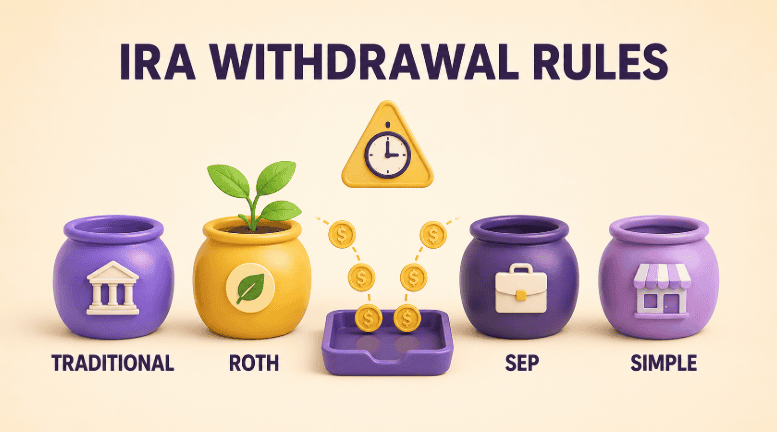
The frustrating part is that the answer changes depending on which IRA you have. A Traditional IRA, a Roth IRA, a SEP IRA, and a SIMPLE IRA all play by different rules, and a couple of those rules (like the SIMPLE IRA's two-year penalty window or the Roth 5-year clock) trip up even people who've had these accounts for years.
This guide breaks down exactly when you can withdraw from each account type, what it'll cost you if you do it early, and when the IRS requires you to start taking money out whether you want to or not. Whether you're weighing an early withdrawal, planning around required minimum distributions, or just want a clear answer before you talk to your tax advisor, you'll find it below.
Every IRA type follows the same core age threshold: 59½. Withdraw before that age and you generally owe a 10% penalty on top of regular income tax. Withdraw after that age and the penalty disappears, though income tax rules still differ by account type. Where it gets more specific is in the details: how a SIMPLE IRA's first two years work differently, when Roth IRA earnings become tax-free, and when the IRS forces you to start taking money out at all. Let's go through each account type one at a time.
Traditional IRA withdrawal rules
A Traditional IRA is funded with pre-tax or tax-deductible contributions that grow tax-deferred. You pay income tax when the money comes out.
Before age 59½: Withdrawals are taxed as ordinary income and subject to a 10% early withdrawal penalty, unless you qualify for an exception.
After age 59½: No penalty applies. Withdrawals are still taxed as ordinary income, since the original contributions were tax-deductible.
Required minimum distributions (RMDs): Traditional IRA owners must begin taking RMDs once they reach their RMD age, which depends on birth year:
- Born 1951–1959: RMDs start at age 73
- Born 1960 or later: RMDs start at age 75
The first RMD is due by April 1 of the year after you reach your RMD age. Every RMD after that is due by December 31 of that year.
SEP IRA withdrawal rules
A SEP IRA (Simplified Employee Pension) is funded entirely through employer contributions, but once the money is in the account, it is withdrawn under the exact same rules as a Traditional IRA.
- 10% early withdrawal penalty before age 59½, unless an exception applies
- All withdrawals are taxed as ordinary income
- RMDs begin at age 73 (born 1951–1959) or age 75 (born 1960 or later)
- First RMD due by April 1 of the following year, then annually by December 31
There is no separate SEP-specific withdrawal rule. If you understand Traditional IRA withdrawals, you understand SEP IRA withdrawals.
SIMPLE IRA withdrawal rules
SIMPLE IRAs follow Traditional IRA rules with one major exception: a much steeper penalty during the first two years of participation.
- Within the first 2 years: Withdrawals before age 59½ are penalized at 25%, not the standard 10%. The two-year clock begins on the date your employer makes your first contribution to the account, not your hire date and not the start of a calendar year.
- After the first 2 years, before age 59½: The penalty drops to the standard 10%, and the account functions like a Traditional IRA from that point forward.
- After age 59½: No penalty. Ordinary income tax still applies.
- RMDs: Once the two-year window has passed, SIMPLE IRAs follow the same RMD rules as a Traditional IRA. Your RMD start age depends on your birth year: 73 if born 1951–1959, 75 if born 1960 or later. The first RMD is due by April 1 of the year after you reach that age, with subsequent RMDs due by December 31 each year.
- Rollover restriction during the 2-year window: During the first two years, a SIMPLE IRA can only be rolled into another SIMPLE IRA. Rolling into a Traditional IRA or a 401(k) during that window is treated as a taxable distribution and triggers the 25% penalty.
If your employer made your first SIMPLE IRA contribution on March 1, 2026, the two-year window runs through March 1, 2028. Any withdrawal before that date (if you're under 59½) is subject to the 25% penalty. A withdrawal on or after March 1, 2028 falls under the standard 10% rule.
Roth IRA withdrawal rules
A Roth IRA is funded with after-tax dollars, so the withdrawal rules are structured around two separate categories: contributions and earnings.
- Contributions: The money you deposited can be withdrawn at any time, at any age, completely tax-free and penalty-free. This is because you already paid income tax on it before contributing.
- Earnings before age 59½ or before the 5-year mark: Taxed as ordinary income and subject to a 10% penalty, unless an exception applies.
- Earnings after age 59½ AND after the account has been open at least 5 years: Completely tax-free and penalty-free. Both conditions must be met.
- RMDs: Roth IRAs have no required minimum distributions during the original owner's lifetime, regardless of birth year. This is the one IRA type where the IRS does not force withdrawals, allowing the account to keep growing tax-free indefinitely.
The Roth IRA 5-year rule
The 5-year rule is the single most misunderstood part of Roth IRA withdrawals. It determines whether earnings (not contributions) come out tax-free.
How the clock starts: The 5-year period begins on January 1 of the tax year of your first Roth IRA contribution, regardless of the exact date you made that contribution.
Roth conversions have their own clock: Each conversion from a Traditional IRA to a Roth IRA starts its own separate 5-year period for penalty purposes, distinct from your contribution-based 5-year clock.
| First contribution year | Withdrawal year | Age 59½ or older? | Result |
|---|---|---|---|
| 2024 | 2027 | Yes | 5-year rule not met yet, earnings are taxable |
| 2022 | 2028 | Yes | 5-year rule met, earnings are tax-free |
| 2024 | 2027 | No | Earnings taxable, 10% penalty may apply |
| 2021 | 2028 | No | Earnings taxed unless due to death, disability, or first-time home purchase, penalty may still apply |
Even if you're over 59½, your Roth earnings aren't automatically tax-free. The account also has to clear the 5-year mark.
Required minimum distributions (RMDs) explained
RMDs apply to Traditional, SEP, and SIMPLE IRAs. Roth IRAs are exempt during the original owner's lifetime.
RMD start age by birth year:
- Born 1951–1959: age 73
- Born 1960 or later: age 75
This two-tier system comes from the SECURE 2.0 Act, which raised the RMD age in phases. It replaced the earlier flat age-72 rule and will not change again until 2033.
Deadlines:
- Your first RMD is due by April 1 of the year after you reach your RMD age.
- Every RMD after that is due by December 31 of that calendar year.
- If you delay your first RMD to April 1, you'll owe two RMDs in that same calendar year, which can push you into a higher tax bracket. Many account holders choose to take their first RMD in the year they actually turn 73 or 75 instead of delaying.
How RMDs are calculated: The IRS calculates your RMD by dividing your account's prior year-end balance by a life expectancy factor from the IRS Uniform Lifetime Table. The RMD is a floor, not a ceiling — you can always withdraw more than the required amount.
What happens if you miss an RMD
If you fail to withdraw your full RMD by the deadline, the IRS charges an excise tax on the shortfall.
- The penalty is 25% of the amount you should have withdrawn but didn't.
- The penalty drops to 10% if you correct the shortfall within a two-year correction window.
This is a meaningful change from older rules, which imposed a flat 50% penalty on missed RMDs. SECURE 2.0 reduced that rate, but a missed RMD is still one of the costliest IRA mistakes an account holder can make, so tracking your RMD deadline every year matters.
Exceptions to the 10% early withdrawal penalty
These exceptions waive the 10% penalty (and the SIMPLE IRA 25% rate where applicable) but generally do not waive income tax on the withdrawal. They apply to Traditional, SEP, and SIMPLE IRAs:
- Total and permanent disability
- Death, with funds distributed to a beneficiary or the owner's estate
- Terminal illness, certified by a physician, with an expected death within 84 months
- Distributions to qualified military reservists called to active duty
- First-time home purchase, up to a $10,000 lifetime limit
- Postsecondary education expenses
- Substantially equal periodic payments (SEPP) taken under IRS guidelines
- Unreimbursed medical expenses above 7.5% of adjusted gross income
- An IRS levy on the IRA
- Health insurance premiums, after receiving at least 12 consecutive weeks of unemployment compensation
- Birth or adoption of a child, up to $5,000 per parent per child, withdrawn within 1 year of the event
- Domestic abuse victim distributions, up to the lesser of $10,000 (inflation-indexed) or 50% of the account balance, self-certified (added by SECURE 2.0)
- Emergency personal expense distributions, one distribution up to $1,000 per calendar year (added by SECURE 2.0)
- Federally declared disaster distributions, up to $22,000
For Roth IRA earnings specifically, the exception list is narrower: disability, death, and first-time home purchase (up to $10,000 lifetime) are the main exceptions that waive both tax and penalty on earnings withdrawn early.
Comparison table: all four IRA types
| Account type | Penalty before 59½ | Special early rule | RMDs required |
|---|---|---|---|
| Traditional IRA | 10% | None | Yes, age 73 (born 1951–59) or 75 (born 1960+) |
| SEP IRA | 10% | None | Yes, age 73 (born 1951–59) or 75 (born 1960+) |
| SIMPLE IRA | 10% (25% in first 2 years) | 25% penalty and restricted rollovers during first 2 years | Yes, age 73 (born 1951–59) or 75 (born 1960+) |
| Roth IRA | 10% on earnings only | Contributions always penalty-free; 5-year rule applies to earnings | No, ever, during owner's lifetime |
This article is for general educational purposes and does not constitute tax, legal, or financial advice. IRA withdrawal rules involve individual circumstances that can change the outcome. Consult a qualified tax professional or refer to IRS Publication 590-B before making a withdrawal decision.
FAQs
About the Author

Not sure which plan fits?
Answer three quick questions about team size and budget - we'll match you to a plan, no reading required.