Contents
- Two forms, months apart, that have to agree with each other
- The line that trips people up: 5a/5b, not 4a/4b
- What your 1099-R actually says, and why it might look wrong
- Distribution code cheat sheet for this specific move
- The letter that means nothing went wrong (probably)
- Don't forget the state piece
- Before you file
- FAQs
- Article Sources
You did everything right. The SIMPLE IRA was old enough, the money moved, the 20% withholding either never applied or you covered it yourself and got it back. Then tax season arrives, and a letter shows up from the IRS asking why you didn't report income. Here's the part almost nobody explains reporting a rollover correctly depends on which two lines you use on Form 1040, and the 401(k)-to-SIMPLE IRA version uses different lines than the IRA-to-IRA rollovers most tax software is built around.
- Your 401(k) plan sends a Form 1099-R by January 31. Your SIMPLE IRA custodian sends a Form 5498 the following spring, and the two forms exist to be matched against each other by the IRS.
- Because the money came from a 401(k), the rollover belongs on Lines 5a and 5b of Form 1040, not Lines 4a and 4b. That single line matters more than it sounds like it should.
- If you got a check made out to you (the 60-day route), your 1099-R will show the full amount as taxable in Box 2a, even though none of it is. You correct that yourself on your return, not on the form.
- If the numbers don't line up the way the IRS's matching system expects, you get a CP2000 notice. It looks alarming and usually means nothing went wrong. There's a specific, short way to respond.
- Form 5498 doesn't arrive until late May of the following year, weeks after most people file. That's normal, and it's not something to wait on before filing.
Two forms, months apart, that have to agree with each other
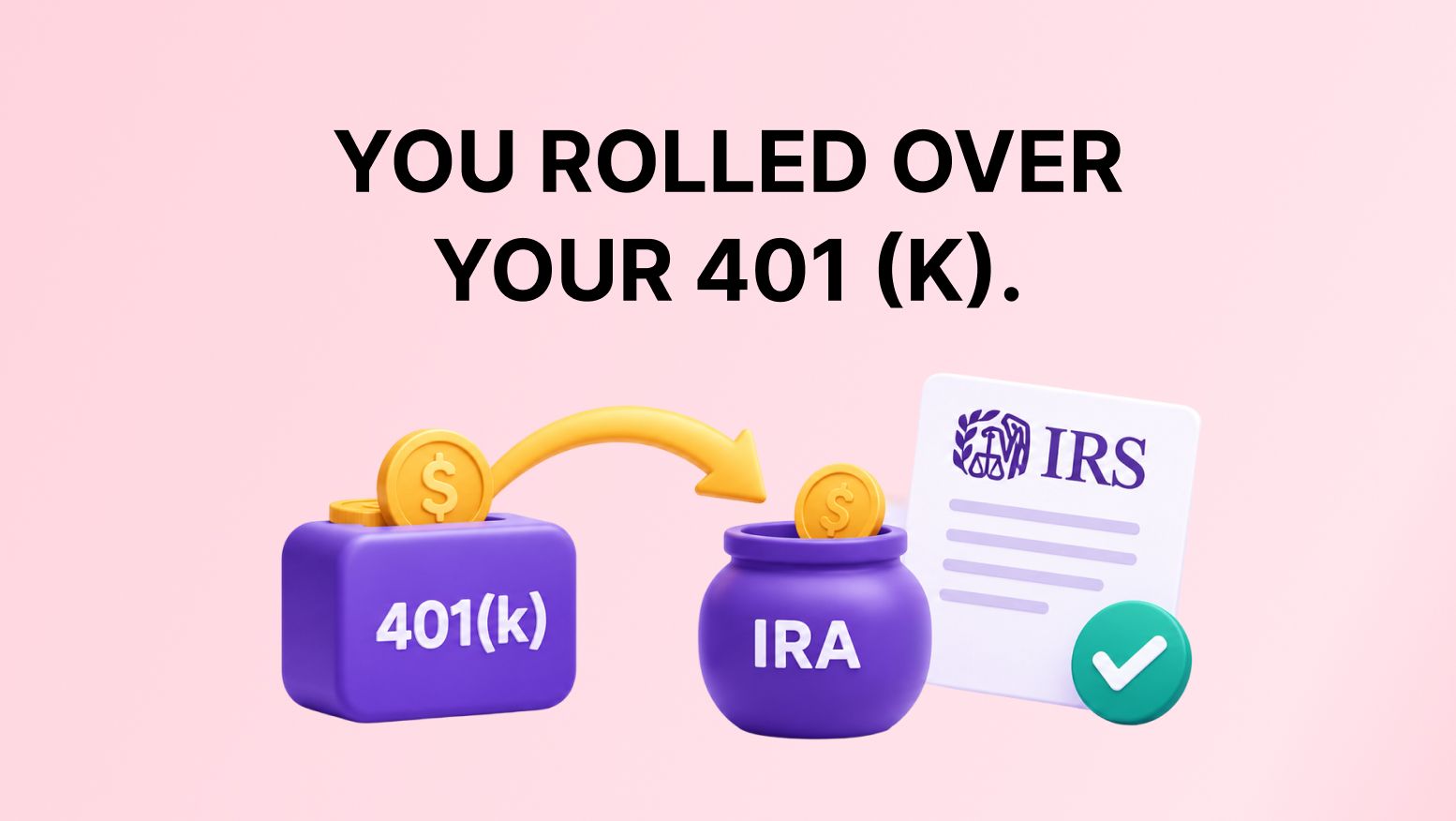
When you rolled your 401(k) into your SIMPLE IRA, you generated a paper trail with two separate documents, sent by two separate institutions, on two separate schedules.
Form 1099-R comes from the 401(k) plan, by January 31 of the year after the rollover. It reports what was left of the old account.
Form 5498 comes from your SIMPLE IRA custodian, and it doesn't show up until May 31 of that same year (June 1 in years when the 31st falls on a weekend, which is when 2026 forms for the 2025 tax year go out). It reports what arrived in the new account, in Box 2, labeled "Rollover contributions."
Nobody files Form 5498 with their return. You can't, since it doesn't exist yet when your return is due. It exists so the IRS can check your math after the fact: does the amount you reported as a nontaxable rollover on your 1040 match the amount your new custodian says actually landed in your account? When those two numbers agree, nothing happens. When they don't, or when the 1099-R shows up on the wrong pair of lines, the system flags it.
That's the part worth getting right before you file, since Form 5498 arriving weeks late means you won't catch a mismatch from that side until it's already an IRS letter.
The line that trips people up: 5a/5b, not 4a/4b
Most of what you'll read online about reporting a rollover assumes an IRA-to-IRA move, because that's the far more common search. IRA-to-IRA rollovers go on Lines 4a and 4b of Form 1040.
Yours doesn't. Because the money started in a 401(k), a qualified employer plan, it belongs on Lines 5a and 5b, the pension-and-annuity lines, even though it's landing in an IRA. This isn't a minor technicality. The IRS's automated matching program checks 1099-R income against the line pair it expects based on the payer type. A 401(k) plan's 1099-R doesn't check the "IRA/SEP/SIMPLE" box in Box 7, because the plan sending the money isn't an IRA. The system is built to expect that income on 5a/5b. Report it on 4a/4b instead, and you can generate a mismatch even though your total tax owed is exactly right.
The fix is one line: enter the gross amount from Box 1 of your 1099-R on Line 5a, enter your taxable amount on Line 5b, and if the full amount was rolled over, that taxable amount is $0, with the word "ROLLOVER" written next to it. That word is doing real work. It's the difference between the IRS reading Line 5b as "no income" versus "income the filer forgot to report."
What your 1099-R actually says, and why it might look wrong
Picking up the $50,000 example from the direct-rollover comparison: whichever path you took, your 401(k) plan issues a Form 1099-R reporting that distribution. What it says in Box 2a and Box 7 depends on which of the two rollover routes you used.
If you did a direct rollover. Box 1 shows $50,000. Box 2a, the taxable amount, shows $0. Box 7 shows Code G. This is the version that causes the least friction. The plan already told the IRS the distribution was tax-free, so there's nothing to correct. You still report it, on Lines 5a/5b with "ROLLOVER" noted, but you're transcribing a form that already agrees with you.
If you did the 60-day rollover. This is where people get an unpleasant surprise. Your 401(k) plan doesn't know, and has no way of knowing, that you're going to deposit the full amount into your SIMPLE IRA within 60 days. From the plan's perspective, it paid a distribution to you. So Box 1 shows $50,000, and Box 2a shows $50,000 too, as fully taxable. Box 7 shows Code 1 if you're under 59½, or Code 7 if you're 59½ or older.
Opening that form and seeing your entire rollover marked as taxable income is alarming if you don't know to expect it. It isn't a mistake on the plan's part, and it isn't something you call them to fix. The 1099-R reflects what happened at the moment the check was cut. What happened afterward, the fact that you deposited the full $50,000 (including the 20% you covered out of pocket) into your SIMPLE IRA within the 60-day window, is something only you can tell the IRS, and you tell it by overriding that number yourself: gross distribution of $50,000 on Line 5a, taxable amount of $0 on Line 5b, "ROLLOVER" written beside it.
Distribution code cheat sheet for this specific move
| Code | What it means here | When you'll see it |
|---|---|---|
| G | Direct rollover from the 401(k) straight to your SIMPLE IRA custodian | You never touched the money |
| 1 | Early distribution, no known exception | 60-day rollover, you're under 59½ |
| 7 | Normal distribution | 60-day rollover, you're 59½ or older |
None of these codes, by themselves, mean you owe tax. They describe how the money left the plan, not whether the move was ultimately taxable. What makes it taxable or not is what you actually did with the money and how you report that on your return.
The letter that means nothing went wrong (probably)
If the numbers don't reconcile the way the IRS's system expects, whether because a rollover landed on the wrong line pair, because Form 5498's Box 2 total doesn't match what you reported, or simply because the system's automated matching flagged the gap between a $50,000 Box 2a and a $0 you claimed, you may get a CP2000 notice. It arrives as a formal-looking letter proposing additional tax, sometimes with penalties and interest attached, and it can be unsettling to open.
Two things are worth knowing before that letter ever shows up. First, a CP2000 is a proposal based on an automated comparison, not a final bill, and not an audit. Second, when the underlying issue is a properly executed rollover, responding to it is usually short: you point to the Form 5498 from your SIMPLE IRA custodian showing the rollover contribution in Box 2, note the "ROLLOVER" annotation already on your filed return, and explain in a sentence or two that the distribution was rolled over within the required window rather than kept as income. Keep a copy of your custodian's rollover confirmation and, if you did the 60-day route, proof of the deposit date, since those are exactly what a response to this kind of notice needs.
The best way to avoid ever seeing this letter is the one already covered in reporting the numbers correctly the first time: right line pair, $0 on 5b, "ROLLOVER" noted. Most CP2000 notices tied to rollovers trace back to one of those three things being off.
Don't forget the state piece
If your state was one of the ones that layers its own mandatory withholding on top of the federal 20%, that state withholding needs its own reconciliation on your state return, separate from the federal Lines 5a/5b entry. The mechanics vary by state, but the principle is the same one that applies federally: you're not trying to make the withheld amount disappear, you're trying to show a tax authority that the full amount was rolled over so the withholding gets credited back rather than treated as tax owed. If you're not sure whether your state applies its own withholding, your 401(k)-plan administrator can confirm before you ever request the distribution, which is a much easier time to find out than after your state refund looks smaller than expected.
Before you file
- Confirm which route you used (direct or 60-day), since that determines what your 1099-R's Box 2a and Box 7 will show.
- Report the distribution on Lines 5a/5b, not 4a/4b, because the source was a 401(k).
- If the full amount was rolled over, put $0 on Line 5b and write "ROLLOVER" next to it.
- Don't wait for Form 5498 to file. It arrives in late May of the following year, well after most filing deadlines, and there's nothing to amend just because it shows up late.
- Keep your rollover confirmation from your SIMPLE IRA custodian and, for a 60-day rollover, the deposit date. If a CP2000 notice ever arrives, that's what resolves it.
If you're still deciding how to move an old 401(k) into your SIMPLE IRA in the first place, the direct rollover avoids most of this. No 20% withholding, no 60-day clock, and a 1099-R that already shows $0 taxable before you've written a word on your return.
This article is for general education and is not tax or legal advice. Retirement account rules are detailed and change over time, and every situation is different. Please talk with a qualified tax professional about your specific circumstances before filing.
FAQs
About the Author

Not sure which plan fits?
Answer three quick questions about team size and budget - we'll match you to a plan, no reading required.