Contents
- The 2-year rule
- Two ways to move the money
- How the 60-day rollover works, step by step
- The 20% withholding trap
- The 60-day clock is firm
- If you miss the deadline anyway
- One rule that does not apply here
- Why we recommend the direct rollover
- If your 401(k) has a loan against it
- If your 401(k) holds stock or other investments
- A note on Roth money
- Before you request a distribution
- FAQs
- Article Sources
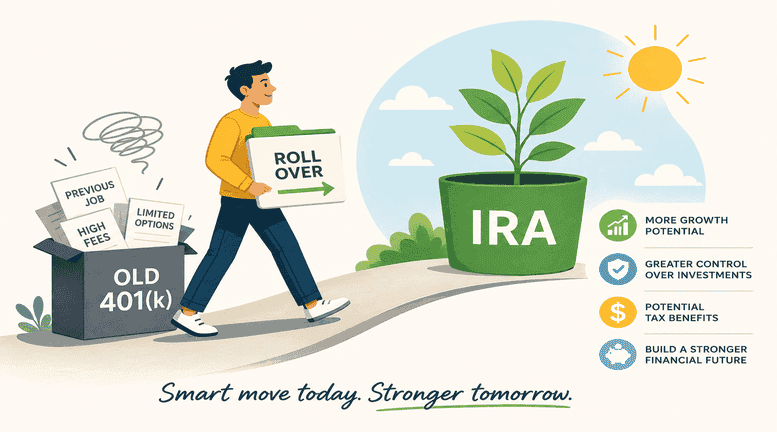
If you have an old 401(k) sitting with a former employer and you now save through a SIMPLE IRA, bringing that money together in one place makes sense. Fewer accounts mean less to track, one set of statements, and a clearer picture of where you stand for retirement.
Moving the money is allowed, but there are rules worth understanding before you start. The 60-day rollover, in particular, comes with a common and expensive trap. Here is how it actually works, in plain terms.
- The 2-year rule comes first. Your SIMPLE IRA must be at least two years old before it can accept money from a 401(k).
- The 20% withholding trap is the costly part. A 60-day rollover gets 20% withheld automatically, but you must deposit 100% to avoid taxes.
- The 60-day deadline is firm. Miss it, and the undeposited amount becomes taxable, plus a possible 10% early withdrawal penalty. A narrow self-certification process exists for specific situations, but it is not a safety net to plan around.
- A direct rollover skips all of this. No withholding, no countdown, no out-of-pocket cash. It is the best path for almost everyone.
- A few situations change the math. An outstanding 401(k) loan, employer stock in the account, or a state with its own withholding rule all add a wrinkle worth checking before you start.
The 2-year rule
Before you move a dollar, check the age of your SIMPLE IRA.
Eligibility check: a SIMPLE IRA can only accept a rollover from a 401(k) after it has been open for at least 2 years. The clock starts on the date of the first contribution to your SIMPLE IRA. During those first two years, it can only receive money from another SIMPLE IRA.
So, the first question is simple: has it been more than two years since your SIMPLE IRA received its first contribution? If yes, you can move your 401(k) into it. If not, you will need to wait until you pass the two-year mark or roll the 401(k) into a traditional IRA in the meantime.
Two ways to move the money
Once you are past the two-year mark, there are two ways to get your 401(k) balance into your SIMPLE IRA.
A direct rollover. Your 401(k) plan sends the money straight to your SIMPLE IRA provider. You never touch it. This is also called a trustee-to-trustee transfer.
A 60-day rollover. Your 401(k) plan sends a check to you. You then have 60 days to deposit that money into your SIMPLE IRA yourself. This is also called an indirect rollover.
Both can be done without triggering taxes, but they are not equally easy to get right. The 60-day version is where people get tripped up, so it is worth walking through carefully.
One detail that trips people up in the other direction: sometimes a "direct" rollover still shows up as a check in your mailbox. If the check is made payable to your SIMPLE IRA custodian, for your benefit, rather than to you personally, it is still a direct rollover even though you are the one who drops it in the mail or hands it to your bank. No 20% withholding applies, because the plan never paid the money to you. The test is whose name is on the check, not whose hands it passes through. If you get a check like this, do not deposit it into your own bank account first. Forward it to your SIMPLE IRA custodian as instructed.
Not sure which rollover fits your situation? Talk to us and we will walk through it with you.
How the 60-day rollover works, step by step
- You request a distribution from your 401(k) and ask for it to be paid to you.
- The plan sends you a check, and the 60-day clock starts the day after you receive it.
- You deposit the money into your SIMPLE IRA within 60 days.
- As long as you deposit the full amount in time, the move is treated as a rollover and no tax is due.
That sounds straightforward. The problem is hidden in step two, and there is a second, smaller trap in step three.
The clock is based on the day you actually receive the check, not the date printed on it and not the day the plan mailed it. If a check sits in your mailbox for a week while you are traveling, or the plan is slow to mail it, that time still counts against your 60 days. Note the postmark or delivery date when it arrives, and do not assume you have a fresh 60 days from whenever you happen to open the envelope.
The other detail: the deposit has to land in the SIMPLE IRA within 60 calendar days, weekends and holidays included. There is no rounding up to the next business day if day 60 falls on a Sunday. Plan to deposit with a few days of buffer rather than aiming for the deadline itself.
The 20% withholding trap
When a 401(k) pays a distribution directly to you, federal law requires the plan to withhold 20% for taxes before it cuts the check. This is mandatory. You cannot waive it, even if you tell the plan you intend to roll the money over within 60 days.
To complete a tax-free rollover, you have to deposit the full original amount into your SIMPLE IRA, not just the amount you received. An example makes it clear.
On a $50,000 401(k) balance:
| What happens | Amount |
|---|---|
| Plan withholds 20% | $10,000 held back for taxes |
| Check you receive | $40,000 |
| Amount you must deposit | $50,000 (the full original balance) |
| Gap you cover yourself | $10,000 from your own cash, until tax time |
| The $10,000 back | Refunded or credited when you file and show a full rollover |
If you only deposit the $40,000 you received, the other $10,000 is treated as a taxable withdrawal. If you are under age 59½, that $10,000 can also get hit with a 10% early withdrawal penalty on top of the tax.
Where does the $10,000 come from? Most people cover it from a savings or checking account, then get it back the following spring as part of their tax refund (or a smaller tax bill), once the full rollover is reported. It is a real, temporary cash outlay, not a paper adjustment, which is exactly why the direct rollover is worth asking for first.
A related wrinkle: you are allowed to roll over only part of the distribution if you want. Say you decide to keep $10,000 in cash and roll over the rest. In that case, only the portion you actually deposit within 60 days avoids tax, and the 20% already withheld still counts toward the amount you needed to replace on the part you intended to roll over. Partial rollovers are legal, but they make the math easy to get wrong, so many people find it simpler to roll over the full amount and take a separate withdrawal later if they need cash.
Also check your state. Federal law sets the 20% withholding, but a number of states layer on their own mandatory withholding for retirement plan distributions, on top of the federal amount. If your state is one of them, the check you receive will be smaller than the "80% of the balance" the federal math alone would suggest, and you will need to cover that state amount out of pocket too if you want a full rollover. Your plan administrator can tell you the exact withholding that applies before you request the distribution.
The 60-day clock is firm
The 60 days is a hard deadline, counted from the day after the check arrives. Miss it, and the entire amount you failed to deposit becomes a taxable distribution for that year, plus the 10% early withdrawal penalty if you are under 59½. There are narrow exceptions for situations outside your control, but you do not want to rely on them. Treat the 60 days as fixed.
If you miss the deadline anyway
The IRS does allow a self-certification process for a short list of specific reasons: things like an error made by the financial institution handling the transfer, a distribution check that was lost or never cashed, or the death or serious illness of a family member around the time of the distribution. If one of these applies to you, you can sign a certification letter to your SIMPLE IRA custodian stating the reason and complete the rollover as soon as the obstacle is resolved, generally within 30 days of it clearing.
Two things to understand about this option before counting on it. First, self-certification is not an automatic extension. It only works if your situation genuinely matches one of the IRS-listed reasons, "I forgot" or "I was busy" is not on the list, and the IRS can still challenge the rollover later if it audits your return. Second, the custodian is allowed to rely on your certification in good faith, but that does not make the rollover bulletproof if the facts do not hold up. This process exists for real emergencies, not as backup planning. Aim to make your deposit well inside the 60 days and treat self-certification as a last resort, not a plan B.
One rule that does not apply here
You may have heard that you can only do one 60-day rollover every 12 months. That limit applies to moving money from one IRA to another IRA. It does not apply to moving money from an employer plan like a 401(k) into an IRA. So a 401(k) to SIMPLE IRA rollover does not count against that once-per-year limit.
Why we recommend the direct rollover
| Direct rollover | 60-day rollover | |
|---|---|---|
| 20% withholding | None | Yes, mandatory |
| 60-day deadline | None | Yes, hard deadline |
| Cash out of pocket | None | Cover the 20% yourself |
| Best for | Almost everyone | Rare cases only |
For almost everyone, the direct rollover is the better path. When the money moves straight from your 401(k) to your SIMPLE IRA provider, there is no 20% withholding, no 60-day countdown, and no need to front thousands of dollars of your own cash. The money simply moves, and the paperwork does the rest. The 60-day rollover exists for situations where a direct transfer is not available. If that is not you, choose the direct rollover and skip the risk.
If your 401(k) has a loan against it
If you still owe money on a 401(k) loan when you leave your job, most plans will "offset" your account balance by the outstanding loan amount rather than letting you keep both the loan and the balance. That offset is treated as a distribution to you, and it is taxable unless you come up with the loan amount yourself and roll it over.
Here is the nuance worth knowing: if the offset happens because you left your job or the plan terminated, you are not stuck with the usual 60-day window for that portion. Federal rules give you until your tax filing deadline for that year, including extensions, to roll over the offset amount. That can push the effective deadline as far out as mid-October of the following year. This extended deadline applies only to the loan offset piece, not to the rest of your account balance, which still follows the normal 60-day (or direct rollover) rules. If this applies to you, it is worth confirming with your plan and a tax professional exactly which portion of your distribution qualifies for the longer window.
If your 401(k) holds stock or other investments
Most 401(k) rollovers involve cash, but if your account holds employer stock or other securities rather than a cash balance, a 60-day rollover works a little differently. The general rule is that you roll over the same property you received. If the plan distributes shares of stock to you, you generally need to either roll over those actual shares into your SIMPLE IRA or sell them and roll over the cash proceeds. You cannot keep the stock and separately deposit unrelated cash of equal value and call it a rollover.
If you plan to sell, be mindful of two things: market movement between the distribution and the sale changes how much cash you have to roll over, and the sale itself needs to happen with enough time left to still deposit the proceeds inside the 60-day window. This is one more reason a direct rollover, where the plan and the SIMPLE IRA custodian coordinate the transfer of the actual account balance, tends to be the cleaner option when non-cash assets are involved.
A note on Roth money
Pre-tax 401(k) money rolls into a SIMPLE IRA as a tax-free rollover when it is done correctly. Roth 401(k) money is different. It cannot go into a SIMPLE IRA and should be rolled into a Roth IRA instead. If your old 401(k) holds both, ask your provider to separate them so each type lands in the right kind of account.
Before you request a distribution
Moving a 401(k) into a SIMPLE IRA can simplify your retirement savings, but the details decide whether it stays tax-free. Confirm your SIMPLE IRA has been open for at least two years, choose a direct rollover whenever you can, and if you ever take the 60-day route, remember that you must redeposit the full amount, including the 20% that was withheld, inside 60 days.
At WealthRabbit, our team can walk you through the process and coordinate a direct rollover, so your money moves cleanly, with none of the withholding headaches. If you have an old 401(k) you would like to bring into your SIMPLE IRA, talk to us and we will handle the details.
This article is for general education and is not tax or legal advice. Retirement account rules are detailed and change over time, and every situation is different. Please talk with a qualified tax professional about your specific circumstances before moving retirement funds.
FAQs
About the Author

Not sure which plan fits?
Answer three quick questions about team size and budget - we'll match you to a plan, no reading required.